My irregular musings on city life, politics, baseball, roller derby, and whatever happens to be getting my goat today.

Tuesday, October 18, 2005

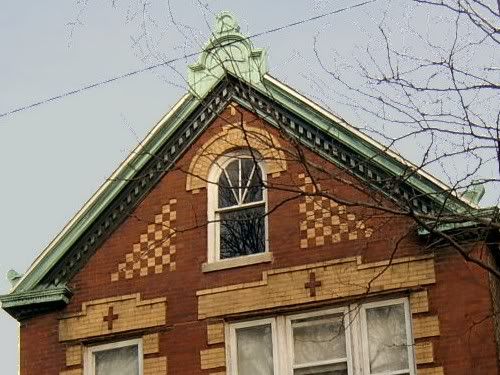
Demolition of the Week: Chez Roberta

Image hosted by Photobucket.com
Roberta's house on Webster, last December

Well, our house has been more or less patched together, but the rest of the neighborhood continues to disappear one building at a time.

The most recent loss was, in my opinion, a real classic. The house at the northwest corner of Webster and Hoyne appears to have been built as an apartment building, but it has spent the past few decades as a single family home. Roberta, a friend from Tai Chi who lived there until a year or so ago, grew up there with her parents and 12 brothers and sisters. The family bought the house back in the 1950s when they moved to Chicago from South Dakota - recently her parents retired for good and decided to go back to their hometown in the Badlands.

The developers simply offered them too much money to turn down, and never hid the fact that they planned to demolish the property as soon as they sweet-talked the alderman into changing the zoning. Because the house had a small "yard," a small empty corner lot next door, they knew they'd have room to build something a millionaire could love.

Image hosted by Photobucket.com
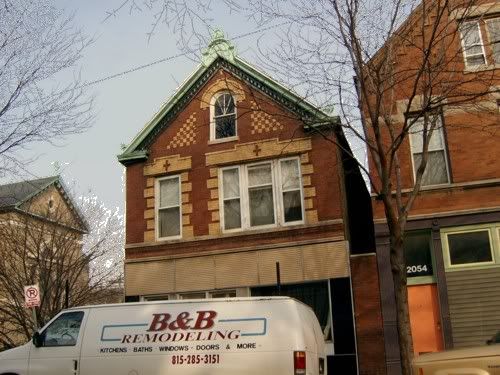
The house was a great example of how attention to decorative detail in a structure can contribute to the neighborhood.

I really liked this one. It was part of a group of buildings that complemented each other and helped establish the neighborhood's character right away as you entered it, walking or driving west on Webster. The whole northeast frontier of Bucktown has been gradually disappearing, being replaced by a generic hodge podge that nobody will really care about, not even the people who live there.

When you add in the fact that a bunch of guys from the gas company just ripped up my impatiens with a back hoe, the neighborhood just doesn't have the charm it did even a week ago.

Thursday, October 13, 2005

The Joys and Sorrows of a 115 Year Old House

So we got back from Ohio on monday and smelled gas as soon as we walked in the door. Trope summoned a guy from the gas company, a nice enough guy, sort of a young black Santa Claus. Santa told us that the line carrying gas in from the street was leaking, and he'd have to shut off the gas to the house until our landlord got it fixed. Also, there was no shutoff valve in the house, so some guys would have to come out, right away, and tear up the front yard to disconnect the gas by, like, smashing the pipe with a backhoe. You couldn't make this stuff up. Using a little clicking device that reminded me of the jury-rigged motion detectors from "Alien," Santa determined that the line in question runs right through the bedroom, and our closets, to the meter at the back of the house. The leak is somewhere south of the stairwell, meaning that a sizeable chunk of wall or ceiling will have to be removed to get at the pipe in question in order to repair it.

So the landlord dispatches a guy he knows who can allegedly fix the pipes. Call him Manny Ramirez. Manny's plan is to remove the gas meter and attach a tank of pressurized CO2 to the gas line, repressurizing it and inspecting it to find the leak. Only it won't repressurize, because the end that's outside isn't really shut off, it's just been smashed by a backhoe. Manny takes off to Home Depot to buy something to plug the hole with, and never comes back.

The next morning Manny's back a little after eight. He borrows my shovel and starts digging around in the big muddy pit the gas company dug for us. Did I mention that they covered it with wooden skids they stole from a nearby construction site? No? Now how could that have slipped my mind?

Anyway, Manny can't fix the pipe because the whole thing is crumbling to the touch now. He says it's original to the house, which is a little scary because the house is a little worker's cottage built in 1890. Apparently in all that time nobody's tried to shut the gas off before and realized that it couldn't be done. In any case, it now looks like the gas company needs to tear up the street, and we need to tear out our ceilings etc. if we ever want to spoil ourselves with hot water again.

I've never been so glad for our gym membership - at least I have somewhere to take a hot shower every morning. But I'm going to start getting testy if I can't cook something soon. And Trope has this thing where she believes that disease is caused by fanciful, invisibly small creatures called "germs" rather than enemy witch doctors, and she tends to like things to get washed in painfully hot water, which is supposed to melt these germs like the witch in "Wizard of Oz." But of course we don't have any of that here.

So we're going to do what any sensible person would do - flee to New York for a few days, and hope we have gas service by the time we get back. If not, we can always break out our terrorist incident emergency stash of MREs. Nutrition: A Force Multiplier!

See ya next week.

Thursday, October 06, 2005

Johnny Saves

I can’t do it.

I can’t root for the White Sox. Not yet, anyway.

I know the arguments on the other side: they’re the best hope for a title-starved town, while Boston has already won their Series at last. And the White Sox are probably the better all-around team, so in some sense they “deserve” to win.

But I just don’t care. And I think a lot of people around town are having the same experience. If you have been watching the media recently, you’d thing Chicago has been swept with a wave of Sox fever, but it’s just not true. Most Chicagoans regard the success or failure of their redheaded stepchild baseball team as irrelevant to their own happiness and well-being. And why should they?

For that matter, why should they care about any sports team? I grew up with baseball, more or less. As we bounced from city to city in my youth, we never really stayed faithful to a baseball team, although my father continued, mostly fruitlessly, to root for the Chicago Bears, which taught me something about humility and identification with the underdog. But when we moved to the Cincinnati area when I was, my father embraced the community wholeheartedly for some reason, and soon we were all pulling for the Bengals and the Reds, two teams that were much better back then than they have been recently.

Summer vacation in those days was embodied by the Reds game on the radio, my father grilling spareribs on the back porch. And, of course, the inevitable end-of-season letdown. I didn’t care that much about the team either way, but trips to Riverfront Coliseum were a treat, what with the junk food, the crowds, and the cool skybridge connecting my father’s office building with the ballpark. That ugly, ugly ballpark has since been replaced by a newer, more intimate field, but I can still see the raw concrete and smell the crowd. In 1990, the Reds led the division from wire to wire and rolled on to the Series. I was too busy starting college, falling in love and getting political to pay too much attention to late season baseball, but I did catch most of the Reds’ four game sweep in the basement of a frat house that was trying to recruit me by plying me with free beer.

A few years later came the strike – the World Series cancelled over a labor dispute? Players and owners both became warring tribes of annoying rich people who cared more about getting richer than they did about the game or the fans. Why did we care about those people anyway? In and of itself baseball is a sublime and beautiful thing, but I’d always been suspicious of fan identification – if you’re not on the team yourself, why does it matter to you which team wins? Most fans are just “rooting for laundry” anyway – backing whoever wears the uniform, not because of who they are, but because of the name of the city scrawled on their jersey (and teams should play for cities, dammit, not states. None of this “Utah,” “Texas,” “Florida” or “Arizona” crap. Not to mention “New England.”) The strike brought this suspicion home to roost. These people didn’t care about us. What fools we were to care about them. I don’t think I watched a single game for the next five years. I ignored the dominance of the evil corporate Yankees in the post-strike era, only paying attention for the Indians’ brief, futile title run, and then only because my ex-girlfriend’s family were such big fans, I sort of hoped on their behalf that the would win. But the Indians, another of the great, hexed teams, ended up losing (Besides the Curse of the Bambino, there is of course Sam Sianis’ goat keeping the Cubs down, the Indians were cursed by the members of the American Indian Movement over their offensive mascot, Chief Wahoo, and of course the White Sox haven’t won since the Black Sox Scandal of 1919, in which the team threw the Series after being paid off by gamblers.)

Then came the post-9/11 era, and the Idiot Mob’s determination to circle their wagons as a response to the attacks. Not only did they decide to rally around the flag and “God Bless America,” (Irving Berlin! So much catchier than the official anthem), they rallied around their loathsome President, and more shocking still, around the New York Yankees. Now I love New York as much as anybody and more than most, and I was deeply affected and horrified by what had happened. But I’m not going to root for the Evil Empire. The Fightin’ Plutocrats are a travesty, an offense against fair play and competition. A $200 million dollar stacked deck. The attempt of a billionaire madman’s ego to buy the championship year after year after year. They were going for their 27th title in 97 tries, and almost the whole country was rallying behind them.

Not me, baby. George Steinbrenner does not need my support. I ended up getting behind a team I had never heard of, a team I swear hadn’t heard of the last time I paid any attention, the Arizona Diamondbacks. Did I mention how annoying I find it when they name teams after states or regions rather than towns? Still, the Diamondbacks were the last thing standing between the Evil Empire and world domination – and all they had were two pitchers named Kurt Schilling and Randy Johnson. I was hooked. They held on through a full seven games, and in the end they beat back the forces of darkness.

Since then, I care about baseball, especially our lovable losers of Lakeview, the Chicago Cubs. They may not always play well, but they play for us. The “tax-hiking, government-expanding, latte-drinking, Sushi-eating, Volvo-driving, New York Times-reading, body-piercing, Hollywood-loving, left-wing freak show” we call Chicago. I think I never understood why people identify with a team before because I’ve never identified with a community. Now that I have a home, I care about it a great deal, and identify with it.

Which is why I can’t get excited about the White Sox. It’s nothing against the team, who are great at what they do. And Ozzie Guillen is always amusing when he tries to talk to the media. But the fans, well, they ain’t us. In fact, the White Sox fans seem to define themselves as “not Cubs fans.” Even now, in the postseason when the team has other teams to worry about, the fans are focused on the Cubs. On my trips to the Cell the past couple days I’ve seen T Shirts and chants of “Cubs suck.” Jokes about dropping friends who are Cubs and Red Sox fans off at the Man Hole, a bar in the predominantly gay neighborhood surrounding Wrigley field. They call us “wine drinkers,” even though wine is for sale at the Cell, while Wrigley sells only beer as far as I know. There’s a cultural fault line here, one that should be familiar to anyone who has read “What’s the Matter with Kansas.” But why should such a rift occur in sky-Blue Chicago, Illinois?

A glance around the Cell on game day reveals a very white crowd, my hulking but friendly tattooed Mexican neighbors for Game 1 aside. This light complexion is striking because the South Side of Chicago is 77% minority, a patchwork of African American and Latino neighborhoods interspersed with a shrinking number of white enclaves on the far Southeast and Southwest sides – and, of course, Chinatown. The Sox themselves are a mix of black and Latin players with a couple of Polish guys and some newcomers from Asia, not so different form the neighborhoods surrounding the ballpark. But the fans? In the stands, anyway, many of them seemed to be descended from the old Irish South Side, today living mostly in the south suburbs since their families abandoned the city in droves in the 70s and 80s rather than live next door to black people. There were a lot of handmade shamrock-adorned “Southside” posters in evidence, at any rate. “Southside” is a state of mind, I guess, a mythical place encompassing the lives and beliefs of neighborhoods throughout the South Side and south suburbs, an attitude more than a real place, a strange amalgam of what was and what might have been. From what I can tell from having lived and worked on the South Side, the actual population there is divided evenly between indifference, Sox fans and Cubs fans. But the real South Side is not the point. Bitterness towards the perceived elite is the point. It seems that regret and shame over what has happened to their communities and envy towards our more engaging lives can both but sublimated into anger and contempt directed at people like me. So we can’t get on a “Sox bandwagon” because we’re not invited. Anyway, as an ESPN radio announcer explained the other day, “there is no Sox bandwagon. That’s the whole point of the White Sox.” If y’all actually enjoy playing the role of ostracized, victimized loser, then more power to you.

This is exactly the kind of ‘false consciousness” that people use to keep themselves down. Compare this false populism of White Sox fans with the broad, community-based authentic populism of Red Sox fans. In the Red Sox cult, everyone from Maine farmers to Boston city slickers to blue collar guys from Lowell are bonded together in the shared experience of human suffering and loss. While the generations-long talk of a “curse” was pretty bogus, the game does teach something about suffering and struggle, inevitability and chance. While you can defy the odds for one day, or one play, in the end the game is about averages – winning percentages, batting averages, earned run averages – and a manager’s job is to line up the numbers just right. So year after year, fans hoped for a miracle, but year after year the numbers didn’t lie. Physics guides the ball, probability guides player performance, reaction inevitably follows action, and the Red Sox lost. Last year, when the finally deviated from the mean enough to win, they gave me something I didn’t know I could still feel – hope. Wonder, awe, and hope.

It’s kind of like my relationship to life, death, and faith. I know what goes up must come down. I know we are all born to die. I know that, over the long term, we are all doomed to war, disease, death. But part of me continues to hold out hope that maybe, somehow, there could be something else. If not immortality, then meaning. Participation in eternity. Hope.

So I can’t root for the White Sox. Not yet. I know they have the better team, the better pitching rotation, and are almost certain to get the one win out of three chances they need to advance to the ALCS. The numbers don’t lie, match the pitchers’ past performance against the hitters and you get a high probability of a Southside sweep. But I’m still hoping for a miracle.

Of course, if they do advance, I’ll be pulling for them against the Yankees next week. Because beating Team Evil is what baseball is all about.
Tuesday, October 04, 2005

Us and Them

A strange column appeared in the Trib last week: folksy observer Charles Madigan discussed the nation’s discovery that there are many poor people in this country. He describes “fixing the poor” as a “Federal fantasy.”
One of the mistakes we make, left, right and center, is to think that the symptom is the actual cause of social illness we decide to attack.

Housing is the solution to the homeless problem in this formula, except it's not. A job, any job, is the solution to joblessness. "Just say `no'" will get you off drugs or alcohol.

Go find someone who is homeless and talk and listen. I have. Right away, I realized, "Having a home is not the big problem here."

It might be substance abuse, a persistent mental health problem, a very bad attitude, whatever. Homelessness is a symptom, not a cause. Any house you put that person in would be a house full of trouble because you have not addressed the cause, just shifted it indoors.

Shelter is good, shelter and professional help are better. But don't be misled. Building lives is harder than building houses.

Poverty, too, is a symptom.

If it were the cause, we could just give money to people to solve it. We tried that a lot of different ways. It didn't work.

I think the solution is a hard one. We have to look at people as individuals, not as members of a race, a class, a displaced slab of society.

If you want a model, go back to the early days of Hurricane Katrina. Helicopter pilots and rescue experts saved one person at a time.

It was difficult and risky.

I believe we can do that, save one person, build one life, at a time.

But we have to be as brave as those rescue workers. We have to look beyond race and class, into the eyes of individuals who need help.

One person at a time? That is a complete fantasy. In fact, it’s a big cop out. Yes, the problems individual people face can make sure that they are the ones who end up poor. But how many people are poor is largely a function of the overall economy, so until we’re willing to address problems on that level, we’re just playing a game of musical chairs with poverty. The way the system’s set up, somebody’s going to get screwed.

Or look at it from another angle. In the same day’s Tribune, from the Tempo section:
Fashion’s polarizing economics
By Guy Trebay
New York Times News Service

NEW YORK – There are probably more scientific ways to measure the bulge at the upper end of the economy, but the season’s hot Prada coat is one way to tell how much disposable income is floating around. The coat is black wool and has jet beading at the lapel and collar. It is fitted, severe, and as chic as widow’s weeds. The person who puts one on immediately assumes the sleek and impertinent air of an urban crow. That the price of the coat is around $5,500 has apparently done little to deter sales. Since the first fall shipments, even the Prada stores have had trouble keeping the coats in stock.

Price resistance is not typically the first thing on people’s minds during Fashion Week, which ended Friday. But even industry die-hards have been forced into a new, and slightly uneasy, relationship with what people outside the business might think of as reality. “I’m a real person and I’m, like, totally sticker-shocked.” Said Lauren Ezersky, the Style channel commentator, befor the Duckie Brown menswear show. An inveterate clotheshorse, she has recently had to cut back on her wardrobe outlay.

“Prices have gotten insane,” Ezersky said, the reasons having to do partly with the continued weakness of the dollar against the euro and partly, one assumes, with the proliferation of an expanded cast of what marketers term the superaffluent. “You used to be able to buy a pear of Manolos for $500, and now every pair of shoes is 800 bucks,” she said indignantly.

For most Americans, the idea of buying a $500 pair of Manolo Blahnik shoes is so far outside the realm of the possible that it is not so much an aspiration as a delusion.
. . .
So when Simon Doonan, the creative director of Barneys New York, said last week that business was surprisingly strong, it was with the caveat, “I’m shocked that there’s no price resistance anymore.” For this season’s must-have jacket from Marc Jacobs, Doonan said, Barneys shoppers will blithely pay $4,000.
. . .
“I’m personally in a little bit of a strange economic bracket, so I don’t really look at price tags,” the lingerie entrepreneur Sarah Siegel-Magness said at the Esteban Cortazar show on Friday afternoon, as her 6-year-old daughter, Camryn, dressed in a Burberry sundress, squirmed in her lap.

Siegel-Magness is the daughter of Mo Siegel, the former Colorado hippie who made his fortune on Celestial Seasonings herbal teas. And she is married to Gary Magness, the son of the late cable television magnate Bob Magness, whose fortune was estimated by Forbes at $875 million in 2004.

“My friends look at the prices of my clothes and my bags, and they’re like, you’ve got to be kidding.” Said Siegel-Magness, who flies in from Boulder, Colo., to attend the twice-yearly New York collections for the fun of it and because, as she said, “If I only lived in my world, I would be out of touch.”

Quote

Uh huh. Don’t see the connection? Apparently some sectors of the economy (herbal tea?) are doing very well while other sectors, such as, ironically, the people who actually make clothing, or used to before their jobs were moved to Asia, are enduring a prolonged and stifling economic stagnation.

Let’s look at another fun area, Manhattan real estate:
Data from Miller Samuel shows the median price per square foot for all Manhattan apartments reached a high point in 1987, at $305 a square foot for co-ops and $413 a square foot for condos. What that means is that the median price for a 1,000-square-foot co-op was $305,000 - half the co-ops sold in Manhattan cost more than that and half cost less.

Prices bottomed out by the mid-1990's, losing about 44 percent of their value in real terms, and then they started to rise again. By 2002, prices had passed their 1987 levels, measured in inflation-adjusted dollars and by the first six months of 2005, the median co-op price was up 37 percent from 1987, while the condo price was 35 percent greater. Averaged across the entire period, the cost of a Manhattan apartment has risen at a rate of about 2 percent a year above inflation.

So what happened to the median income in Manhattan during the same period?
Census data reveals that median household income growth in Manhattan was strong from 1979 to 1989, increasing 35.8 percent above inflation. But in the 1990's, median income - the point at which half the households earned more and half earned less - barely rose, going up just 8.5 percent in real terms from 1989 to 1999, or 0.85 percent a year. Since then, a similar rate of growth has been documented by the Census Bureau in its annual American Community Survey, which shows a 4.1 percent inflation-adjusted increase in the median income for Manhattan from 2000 through 2004, or 0.82 percent a year. The median household income last year in Manhattan was $50,731, according to the Census Bureau.

In other words, since the last peak in the real estate market, Manhattan apartment prices have grown about one and a half times faster than median household income.
Manhattan has the greatest income disparity of any county in the country, and the census data shows that while the household income for the bottom 20 percent rose just 7.9 percent from 1989 to 1999, in real terms, the income of the top 20 percent went up 61.5 percent.

Reasoning that it is mainly earners at the top end who can afford to buy an apartment in Manhattan, a group of economists argues that, despite the galloping price increases of recent years, real estate on the island has actually become more affordable.

The group, Business360, an economic consulting firm, compared the increase in apartment prices per square foot with increases in personal income for Manhattan. While real estate prices rose and fell and rose again, average personal income in Manhattan, reported by the federal government's Bureau of Economic Analysis, rose at a fairly steady pace, increasing 87 percent in real terms since 1981. The figure is very different from the median because it is an average of all earners, and with Manhattan's great income disparity, it is heavily skewed toward the top.

Average income has grown faster than average prices, which since 1981 are up 50 percent for co-ops and 37 percent for condos. Because of that, the study concludes, housing is more affordable for the average Manhattanite than it was in the early 1980's or at the peak of the last real estate boom.

To show the relationship between rising incomes and prices and falling interest rates, Business360 calculated the number of days it would take for the average household to earn enough money to pay a year's mortgage payments for a 1,000-square-foot condo, at the average mortgage rate and square foot price for each year of the study. In 1987, it took 273 workdays to cover the mortgage, while today, the study concluded, it takes 152 days. The average household income for Manhattan, projected by Woods & Poole Economics, is $185,993.

"People look at the prices - they're stratospheric - and they think that that's a bubble," said John Marchant, one of the economists who wrote the Business360 study. "But if they looked at what people are earning in New York, they'd think that's outrageous too."

Ingrid Gould Ellen, the co-director of the Furman Center for Real Estate and Urban Policy at New York University School of Law, said: "It really depends on who your target is when you talk about affordability. For the median earner in Manhattan, those apartments are going to be less affordable, but somebody's buying them."

The truth is, the economy’s growing great. You’re just not benefiting from it. And what happens to the rich affects everyone else. Not only does their increased wealth not “trickle down” to everyone else, it makes life worse for everyone else. The fact is, a fraction of their money could meet whatever needs they have for the rest of their lives. Between the misshapen economy and 5 years of tax cuts, they now literally don’t know what to do with the piles of cash. $1 million for a one bedroom co-op apartment. Sounds reasonable! $2,460 for a really ugly lopsided Marc Jacobs sweater? Sure, whatever.

This kind of behavior drives up prices for the rest of us, making us relatively poorer. This doesn’t show up in government accounting because things like rising real estate and health care prices are arbitrarily counted as economic growth rather than inflation when GDP is calculated. (It’s sort of like the problem that occurs when your house is totaled by a flood. Both the cost of demolishing it and rebuilding it are counted as an economic positive rather than a cost – even though you are spending a lot of money just to get back to where you were – but I digress.)

If you separate their economy from our economy, you will find that they are doing great while we are experiencing stagnation and inflation. Part of the reason is simply that they (owners) are increasing profits by forcing down the wages of everyone else (workers – us). They are breaking unions, dismantling pension systems, cutting back on health benefits, all to increase the share of revenue that goes to owners rather than workers.

We’re not a unified group – some of us are poor, others are clinging desperately to “middle class” status – but we are all getting screwed. If you’re not one of them, it’s getting much harder to support a family on the scraps they leave us.

What’s the solution? Raise their taxes. For now, I don’t even care what you do with it. In spite of Mr. Madigan’s protestations, we have not tried giving money to people “a lot of different ways.” This country has never guaranteed a basic living to its people. Instead we have offered a pittance of social benefits to those so desperate they are willing to humiliate themselves to get them, then take them away at the first sign that the recipients may be working towards self-sufficiency.

But let’s say we had tried it and it didn’t work. Taxing the crap out of the rich would help, even if we just flushed the money down the toilet. Why? Because if we strip away their surplus income, there won’t be anyone left to pay a million dollars for a crappy condo. Then maybe the market will collapse, and I can afford to own a home, too.

If this approach were tried, the media would carp about recession, but you would actually be better off. Just like now, they say there’s growth, but it doesn’t help you any. The media people say that stuff because they’re rich. We’re not, and I harbor no illusions that I’m ever going to join the $800 million herbal tea set. We’re not all in this together. The rich are the class enemy, and no matter how much you admire their threads, what’s good for them is probably not good for you.

Monday, October 03, 2005

Some Idiot

Some idiot stole our basil plant this morning.

Yes, the whole fucking plant. It was there last night when Trope got parsley for the mashed potatoes, and this morning when I left for work it was gone. I doubt the construction guys next door took it - where would they put it? We did talk to a couple homeless guys in the alley about our "crops" one day. But why would they take the basil rather than, say, the rhubarb, which you could actually make into a meal?

Who the fuck steals a basil plant out of the ground? What, they needed to feed their pesto addiction right fucking now?

This is the kind of bullshit that can turn you against a community. Let's just say I like this place, but I'd like it more if I had a gate with a lock on it by the alley and between the houses, like we had across the street.

Be warned, if I catch you tresspassing in my backyard, I'm not going to ask you why you're there. I'm going to beat you to death with a shovel and dump your body in Lake Calumet. So stay out.

Image hosted by Photobucket.com
The Basil in better days.
April 2005 - October 2005

Friday, September 23, 2005

Tied Up in the Cell

We had free tickets for last night's Sox game vs. the Twins, so we took the El down to 35th Street to check it out. The sausages, as usual, were great. At the Ballpark Formerly Known as Comisky, you can get Brats with brown mustard, saurkraut, and grilled onions. The onions get a little soggy by the late innings, but if you get a brat in the 1st they've just started to carmelize . . . my mouth is literally watering as I write this. Anyway, the food's better on the South Side.

The baseball is actually a familiar flavor. A tense pitcher's dual, with a 1-1 tie persisting into extra innings. The Sox bullpen finally collapsed in the 11th, and the Southsiders got spanked 4-1. They left the bases loaded in the 9th and a man on 2nd in the 10th. Chicago baseball in all its glory.

But the fans? I just don't get it. The guys behind me started carping and demanding that Sox manager Ozzie Guillen be fired, after the first out. They screamed "You Suck!" and other obscenities at their own team. They had all but written off the game in the third inning, while it was still tied 0-0. After the Sox went up 1-0, they prayed for rain (and got it, although the game was never delayed).

Keep in mind, while the team has been sagging in recent weeks, they are still in first place. What are these people like when they're trailing? For some of these people, I think a record of 161-1 would not be good enough. "You suck, Guillen. How could you lose that game?"

Worst of all, a group of "fans" in front of me were training an 11 year old to scream along with them. So nice to see a community passing on its values to the next generation.

Sox fans like to mock Cubs fans as wine-drinking elitists who don't know anything about baseball. Guilty as charged, man. And as for the shirt being peddled on 35th Street proclaiming Wrigley Field to be the "World's Largest Outdoor Gay Bar," that's probably true, too. So what's you're point? I'm having fun at the ballpark. My girl, my beer, my brat, the first evening of Autumn and still not cold yet . . . if you're idea of fun is screaming obscenities at your own team, I feel sorry for you. As for the alleged rivalry, there is no rivalry. They envy us, because we know how to live.

Maybe I should have bought a T shirt.

Tuesday, September 20, 2005

Brave New World

Just a little update on what's been going on with the neighborhood. I've stopped posting pictures of demolished buildings recently because I never seem to have the camera handy. But I thought I'd post a couple bfore and after pictures of some of the sites I've talked about in the past so you can see what's happening to the neighborhood and the new world that's emerging on the Near West Side.

Before
Image hosted by Photobucket.com

This building was a neighborhood landmark and a favorite. It was demolished because it was too small, and didn't feature any condos with balconies like the rich people like. They are willing to accept less footage to be able to live close to cool people like me, but they demand a view.

After
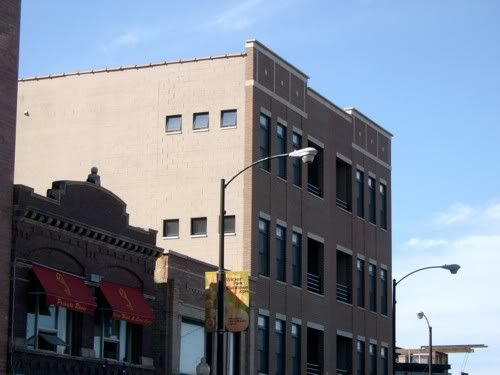
Image hosted by Photobucket.com

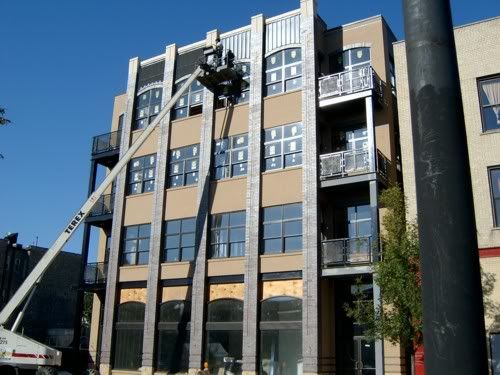
The big problem with this building is that it faces the wrong way. It ignores Damen, Bucktown's main thoroughfare, in favor of Shakespeare, which at a quarter-block south of Webster is not even a real street, since it doesn't fit the grid. From it's balconies, the moneyed classes will be able to gaze south along Damen and see the trendy business district with its boutiques and restaurants and funkily dressed babes, oblivious to the way their homes have deteriorated the quality of life for everyone around them. By facing south, the building presents a side view to Damen Avenue, with little bathroom windows that are asymmetrical, too much empty brick, and the edge of the balconies visible on one side only. In short, it's lopsided, deformed and ugly. The designers apparently decided that if they put retail with an attractive awning on the ground level, nobody will notice how the little group of buildings has become scarred and disfigured.

Image hosted by Photobucket.com

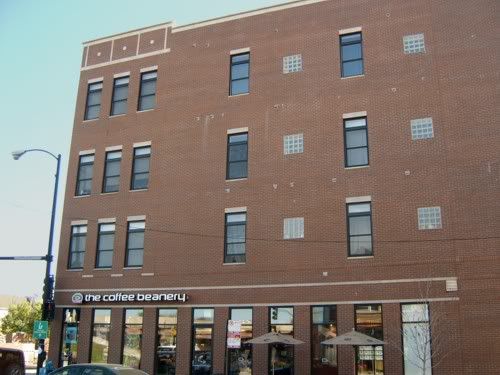
The new condo building at the corner of Damen and Webster, by contrast, faces the right way and even manages to present an attractive and fairly symmetrical face to the residential side street.

Image hosted by Photobucket.com

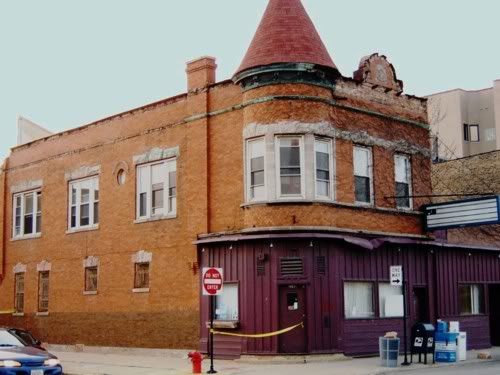
Before
Image hosted by Photobucket.com

An attractive two-story commercial-residential building with decorative 19th Century iron metal details. Not enough units on the property, once again no balcony for rich people to store their bicycles and gas grills.

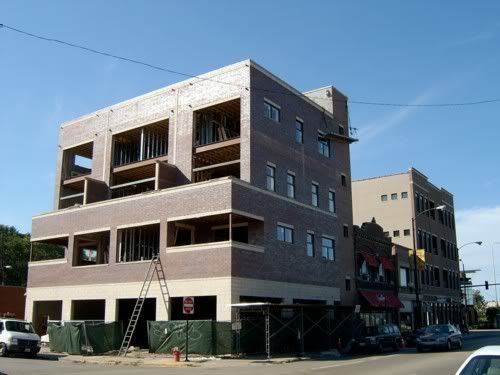
After
Image hosted by Photobucket.com

Fairly attractive modern commercial-residential condo building going up on a portion of the site. This building pays more attention to detail than do most new condos I've seen, the splash of color brightens up what is quickly becoming another shopping/residential quarter. I am pleasantly surprised. An identical building will rise next door, and then a skinny half-building that will look like the right half of this one, on the site ofthe old building. Unfortunately, this four-story complex will pretty much overwhelm the pretty Victorian turret next door.

Still, as industrial uses fade from the area, they are trying to extend the Wicker Park trendiness all the way up to the Congress Theater and beyond. Unfortunately, retail jobs do not pay what industrial jobs did, and people who work in these buildings could never dream of living in them, or increasingly, living in the neighborhood at all. Fortunately there is an El stop a couple blocks NW on Milwaukee.

Image hosted by Photobucket.com

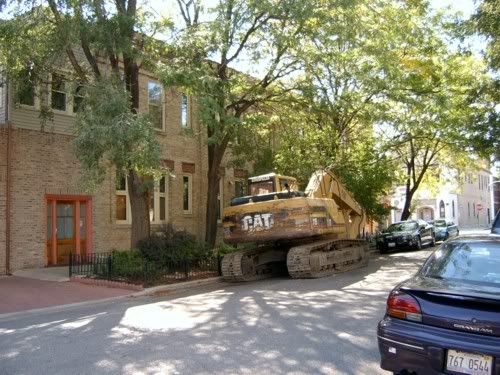
Well, another digger, signifying another teardown is about to take place. I took pictures of all the likely suspects, but I was wrong. A little house that used to be a storefront was the victim. I don't really remember it and I walked by it several times a week for three years, so it's probably not the biggest tragedy ever. Still, I wish these people would leave my neighborhood alone. They are filming a movie here tomorrow so we won't be able to park on our own street. Maybe once people see the 'hood on film, someone (like the Alderman) will conclude it is worth something more than the value of the land underneath it.

Image hosted by Photobucket.com

This doesn't really mean anything, Trope took it and it's just cool (I played with the color a little to make it pop more). If you have any idea what it might represent, drop me a line.