My irregular musings on city life, politics, baseball, roller derby, and whatever happens to be getting my goat today.

Sunday, March 19, 2006

On Monsters

There's a great article in this month's Atlantic magazine about the frightening lengths British intelligence went to infiltrate and destroy the IRA. Their agents participated in shootings and bombings and killed other spies in the process of gathering the intelligence the British needed to break the back of the organization. Agents participated in activities including bombing attacks and the murder of police officers. Many reasonable people would agree that these efforts went too far in pursuit of a goal which may (or may not) be worthy. I am tempted to call the people who ended up doing such things somewhat monstrous.

At what point does order or peace or justice justify immoral or evil behavior? When do the ends justify the means? I confess up front that I really don't know, but that won't stop me from taking a stab at it.

In popular culture, this has become sort of a meme, because art is where we work out the issues that we're ordinarily too polite to talk about as a society. I've noticed three prominent fictional examples of individuals who become monsters in the service of some higher goal. Chiwetel Ejiofor as the Operative in Serenity, Hugo Weaving as the terrorist V in V for Vendetta, and Mary McDonnell's President Roslin in Battlestar Galactica. The Operative is presented as villain, V is presented as (anti-) hero, and as for Roslin, as well as for everyone else in the gloriously ambiguous space opera, the jury remains out. But all three of them do evil in the name of good, to create a better world they won't live to see, so in some ways they're all archetype, looked at from three different perspectives. They claim to know better than the foolish masses, so they use undemocratic, coercive and violent means to enforce their vision on the world. In their own eyes they are making a sacrifice for the greater good by engaging in evil. Jack Bauer on 24 would probably be another great example of this archetype, but since I don't know how his story ends I really can't draw any conclusions about him.

The Operative does monstrous things, including slaughtering an entire town, including children, on the off chance that our heroes may seek refuge there. He does these things in the name of preserving order, stability, and social peace. He thinks the triumph of his side will bring about a better world ("all of them, better worlds"). He has no proof of this, but he believes. He believes (incorrectly) that even though he murders people, the maintenance of order means fewer lives will be lost overall. He recognizes that he's a monster, and says of the coming utopia "I'm not going to live there." There will be no place for men such as himself in a perfected society.

Often in fiction we see such people used to cover up the corruption and cynicism of political leaders, but here it's not so simple. What he's covering up is a holocaust, albeit an accidental one - a drug that was supposed to calm and pacify the public actually killed 30 million people. The Operative does not know this because he never asks what it is he's fighting for.

Verdict: This one's obvious. That the Operative is wrong is the whole point of the movie. TWOPper Jacob wrote in his recap:
I think I just became a fucking Libertarian. And possibly a Christian.
Which sums up the moral universe of the movie pretty well. The Operative's sin is that he thinks he has the right to make decisions for everyone else, and enforce those decisions with violence, because the decisions are "right." But who decides what is right? Politicians? Scientists? Moralists? The Operative doesn't deserve the moral standing he gives himself. In the end, he rejects his old life and appears to be on the way to redemption. The other characters don't seem to care very much, and they have a point - he's a monster.

Laura Roslin is the formerly liberal Secretary of Education who is thrust into the role of President after the 42 people ahead of her in the line of succession are killed in a nuclear attack which decimates civilization. As President she embraces religious prophecy in order to consolidate her political base, and bans abortion when her fundie supporters demand it. Roslin almost routinely orders the execution of prisoners and does not consider the enemy to be persons with any rights or moral value. In the season finale, she tries to steal a democratic election, relenting only when she is caught by her chief military leader.

Many fans would justify her actions based on how her enemies behave - the wholesale murder of civilians, suicide attacks, sleeper agents etc. Except we see unapologetic terrorist Samuel Anders employing similar tactics to blow up a civilian cafe in order to drive out the occupying forces - holy HAMAS, Batman! We think that's okay, because he's on our side, right? Except that the specific Cylons he's targeting include the even sympathetic Boomer, programmed to think she's human, as well as Six - who played a key role in destroying the world and thus has it coming - except she feels really bad about it and is trying to find some way to end the war, which makes her what? Hero? Villain? Another monster? But this is not the issue. I'm not asking if Roslin's behavior is emotionally satisfying, I'm asking whether it's justified.

Verdict: Laura is meant to be controversial and difficult to pin down. Her backing down and conceding the election is supposed to mean that she stands at the precipice but is not a monster (yet). I disagree. Her horrible treatment of POW Sharon (who wanted to defect, for chrissakes), her execution of other unarmed prisoners including peace emissaries, her general moral obtuseness about the dignity and rights of her enemies, her embracing of fandementalism for political gain - all of these things place her beyond the pale in my eyes. True, she pursues power because she wants "what's best for her people." But who the hell is she to decide that? The show is more sympathetic to her than I am, and conspires to make her right more often than wrong. Settling on the new planet - which she opposed in the election campaign - does lead to disaster and occupation. But she couldn't have known that in advance, and didn't have the right to make everyone's decisions for them, or to decide who is worthy of life and who should die. I say she's a monster. A sympathetic, compelling monster perhaps, but a monster.

Which is not to say I don't like the character. Mary McDonnell deserves an Emmy. In fact the wonderful juxtoposition of the soulful, repentent killing machine Six with the bloody-minded, unapologetically murderous and deceitful human President was one of the high points of my entertainment year, making the episode "Downloaded" (TV guide subscribers can get it for free from iTunes, by the way) probably the best hour of TV I have ever seen.

V is the most obviously "monstrous" of the lot. Clearly a vengeance-obsessed madman, V blows up London landmarks as a call to revolution, and assassinates political, religious and media figures associated with the government. It's a clearly opressive government, however, which has banned both homosexuality and the Koran, as well as most foreigners apparently, and "disappears," tortures, and executes dissidents, as well as using them for medical experiments. Yet V himself is a terrorist, not above kidnapping, torturing and executing people, so where does he get off?

Verdict: He doesn't get off. Like the other two, he won't live to see the world he wants to create. But, crucially, he isn't trying to force his beliefs and views on people or make decisions for them. Quite the opposite - he wants people to be able to make choices for themselves, rather than have decisions made for them by the Government or Party. He may be a monster, but he's our monster.

So what do we conclude from these monsters? For me, the defining issue remains for what do they fight. In cases where the monster's goal is to make other people's choices for them, because they think they know better, becoming a monster is monstrous. There's only one cause worth giving up your soul for. It's not survival, not justice, not God, not patriotism, certainly not "security."

The only reason someone would be justified in monstrous deeds is the preservation and advancement of human freedom. In other words, what's wrong on behalf of the "saints" can be justified on the behalf of sinners. Using violence to exercise power over someone else in the name of one's beliefs or ideology or values, trying to make the world over in one's own image, is monstrous. But fighting in the name of human freedom and self determination is basically just self defense writ large - you can't grow and function normally as a human being without freedom, any more than you can do it without enough food or oxygen.

Live free or die - it's not just a license plate anymore.

Saturday, March 18, 2006

whose machine is this anyway?

So far this year I'm down to about two posts a month! I'm disappointed, even if nobody else out there cares very much one way or the other. My problem is not that nothing interesting is happening, it's that a lot of interesting things are happening, but it's work stuff, and I can't really blog about it. In fact, I don't really feel comfortable doing this at all during work hours. It's not so much that there's more pressure to use time at work productively (there's really not), it's politics. The nature of my employment looks like it's likely to change soon, and if it does I will offically be a public employee.

Which is great for me, but as you might have heard, there's been a lot of scandal surrounding political activity and public employment in Chicago and Cook County lately. So if I were to be working on something even vaguely political on time which is being compensated by the taxpayers would not be just shiftlessness, but illegal and in violation of the city's consent decree as well.

This is why I use a pseudonym and never discuss the department or field in which I work, which has become annoying recently because there's so much to say about it. But even so, I just don't think I can spend any of my convenient office computer time on the Web anymore, which has put a damper on my blogging.

This being Saturday, however, and me feeling sickly and having decided not to attend today's historic Michigan Avenue peace demonstration largely because it's cold and I'm being a wuss about it, I suppose I can spare some time to talk a little politics. Usually I'm fairly partisan, and not only do I know who I'm going to vote for in any given election far in advance, but I'm often actively campaigning for somebody. But this time around I'm stumped.

Tuesday morning is the Illinois Democratic primary, and the big race here is for President of the Cook County board (Board President sounds like a small time job not worthy of much thought until you realize that Cook County contains five and a half million people, roughly 42% of the state population, billions of dollars of tax revenue, and an army of patronage workers as large as any in North America). The Republican doesn't have a prayer, so whoever wins the primary wins the seat - or that's what I would have told you last week, anyway. But events have conspired to make things a bit more interesting.

The race pits longtime encumbent board president John Stroger against up and coming political operative Forrest Claypool. Stroger is one of the most powerful men in the state, and although the political hiring scandals that are spreading like wildfire across the prarie state have so far not reached his doorstep, all these guys who are getting indicted basically work for him, as he's on of the leaders of what they used to call the Machine - the Cook County Regular Democratic Organization. So reformers and Goo-Goos ("good government" advocates) are basically after his hide. In addition to my suspicion that machine politics leads to a bit of waste and inefficiency (although perhaps not as much as you'd assume) I have a bit of a personal grudge against Stroger - his determination to tear down the old Cook County Hospital building, mostly to improve the view of its replacement, which Stroger built and named Stroger Hospital. Since the old building is a classic which developers would like to turn into really nice condos, and the new one looks like a toddler built it out of glass blocks and random pieces of metal junk, I oppose this plan. Fortunately, most of the rest of the board agrees with me and the demolition is on hold while they examine offers to buy the building.

On the other hand. things have gotten quite a bit better in Chicago and Cook County while Stroger's been in charge. Crime and poverty are down, and at least some schools have improved a little. This weeks Economist magazine contains a special section touting Chicago as a success story and a possible model for reversing urban decline in the Rust Belt. So if taking out the trash is the standard by which officeholders are measured, Stroger's had a pretty good tenure.

Claypool, on the other hand, is running as a reformer, and has said everything the Goo-Goos want to hear. Transparency, accountability, etc. In theory I am in favor of these things. On the other hand, Claypool was Mayor Richard Daley's chief of staff at one point, so how independent and reformist can he really be? In addition, while he's widely respected for fixing things at the Park District when he was in charge, I've heard people complain that he was virulently anti-union in that position, and basically balanced the budget on the backs of longtime employees. And I also have a personal grudge against Claypool - he's backing the plan for a third airport at Peotone (along with Rep. Jesse Jackson Junior) over an expansion of O'Hare. The problem with this plan is that Peotone isn't even in Cook County! Basically, he wants to export yet more jobs that could become available for city residents to a distant exurb, just to mollify a few suburbanite mayors who are angry that an O'Hare expansion would demolish some of their oppressively tacky tract homes.

So where does that leave me? Two candidates I could never love, and I vote I have to base on guesswork - which will do less harm to Chicago's future over the next few years?

And then it got complicated. On Tuesday, John Stroger, who is 76 years old and fairly obese, suffered a serious stroke and had to be hospitalized. He's been in the ICU ever since and may or may not recover enough to return to work. So Chicago is faced with its own Ariel Sharon moment. What happens if Stroger wins but is unable to govern, which looks like the likeliest outcome as of this writing? The 80 Democratic committeemen - 50 representing Chicago's 50 wards and 30 from the burbs - will decide among themselves who the next candidate will be. I have no clue who this might be, and whether the official Machine candidate would be better or worse than Claypool. Do I trust those guys to pick a leader, or vote for Claypool, whom I don't like, but could probably live with?

My hunch is that the Board President job will be used as a political tool by the Machine. A longhot idea - perhaps the job will be offered to Jesse Jr. as a payoff to get him to not run for Mayor against Daley. More likely, it will go to some insider or loyalist - like Dan Hynes, the insider who had the oganizational support but failed to gain traction against Barak Obama in the '04 Senate primary. So any way the primary goes, we're in for some upheaval at the top. It's exciting stuff, but it leaves me playing an unfamiliar role - as an undecided voter.

Thursday, March 09, 2006

your philosophical primer for the day

People are evil. Not in the sense of "there are evil people out htere," but in the sense of "all of us are and do evil." We've all done things we regret, or should regret. We hurt or abuse or exploit others in our pursuit of self interest. We put our own convenience over the common good. This is just a part of human nature.

Liberals used to be the guys who said people were basically good and you should cut them some slack. Brian Covell has remaked that part of the decline of the American Liberal worldview had to do with our understanding of hte Holocaust as proof that human beings are fallen and sinful. The good pastor finds this somewhat lamentable, but after the events of the 20th Century, I would look upon with alarm any movement that claimed humand beings were perfect or perfectable.

Due to our sometimes miserable nature, life for much of human history was "nasty, brutish, and short." To deal with our insistant squabbling and murder of each other, the modern state evolved. Rules were developed for people to follow in order to bring relative peace to human relations. This was a vast improvement over the "warring tribes" system, which is what it replaced. In easter Europe, Somalia and Iraq we have witnessed what happens when the State collapses and we return to this brutish existance.

However, hte State has problems of its own. Basic human nature has not changed, so the people who run the government are also evil. They tend to use the power they have been granted to enrich themselves by exploiting everyone else, and work mostly to expand their own power.

To address this problem, Enlightenment thinkers such as the Founders of this nation developed a system under which the leaders of the government would be chosen by and held accountable to the people. Furthermore, they divided up the essential powers of the government among the 3 separate branches of government. They figured that the leaders of each branch woudl work hard to enhance thier own power. This would lead to conflict among the branches, often leaving them at loggerheads. While inefficient, this system would ensure that no one in government would be able to assert complete authority and misuse their offices too badly. The other branches would always be there to hold them accountable.

For example, the executive branch has the power to investigate criminal activity - this is an essential function of the state. Under the "warring tribes" system, when people wronged us, we would take our revenge upon them. In civilized society, we have given up our right of revenge to the State in exchange for its promise to protect us. So the State has a legal monopoly on the use of violence. They can grab people off the street, lock them up, and sometimes kill them. You, however, are not even allowed to throw a punch. "Assault," as it's now called, is a crime.

But what's to stop the leaders of the executive branch from using their monopoly on force to intimidate, threaten, blackmail and silence people in their own self interest? The answer lies in the separation of powers between the branches of government. The laws to be enforced are written by the legislative branch (Congress). Determining whether or not a law has been broken or properly carried out is the job of the courts. The executive just carries out and enforces the will of the other branches, it cannot make the law.

In order to protect people from tyranny, the system is set up to ensure that the government does not normally intrude on the privacy of ordinary citizens. Sometimes it must, but only to protect the public and enforce the law. But in order to do so, the executive must have permission from the other branches of government - they must present evidence to a judge that individual X has broken or is conspiring to break on of Congress' laws. This is part of the system by which each branch is supposed to be restrained by the other two.

So there's you philosophical primer for today. The real world relevance, of course, is that the Bush Administration now claims it has the right to invade peoples' privacy without presenting any evidence to the courts.

This amounts to saying "trust us. We're not going to use these powers against innocent people for our own gain becasue we're good people." But there arent' any good guys in real life, onlu uss self-interested pricks. It is necessary fro the government to investigate and detain people to protect the rest of us from the world of evil pricks outside the governmetn. But who protects us from the evil pricks inside the government? It's supposed to be the other branches of government. Public accountability through separation of powers and the rule of law. But by instituting large scale surveillance in secret, without informing Congress or the courts, the executive branch has proclaimed itself to be above the law.

"Trust us" they say. But trusting the people at the top to be nice is not a good plan for maintaining our liberty and ensuring that Americans will not be persicuted and jailed for political reasons. A much better plan is to keep the separation of powers and the rule of law in place.

We have maintained and expanded our freedom for over 200 years by not trusting anyone. We shouldn't let our fear of evil people out there make us forget that peopel are just as bad on this side of the border.

Friday, March 03, 2006

The Upside of Anger

Image hosting by Photobucket

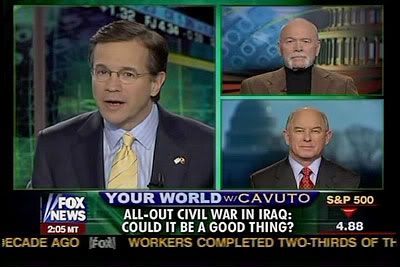
Okay, what the hell. Another contest! Just to see if anybody's still checking this page. This one is inspired by our media overlords at Fox News, and I'm sending it out to all you sarcastic cynics out there, especially my snarky blood relatives. Look at the zany topic of discussion they had the other day on Fox! Those crazy kids! ALL-OUT CIVIL WAR IN IRAQ: COULD IT BE A GOOD THING? You bet it could! Let us count the ways! Post your reasons why genocidal sectarian civil war is good for humanity as comments to this web page. The person with the best reason, as judged by me, gets the greatest prize in the whole world (a case of beer, natch).

Tuesday, February 28, 2006

Bob, I'm working on it

Yeah, so I haven't written hardly at all this winter. There's a couple reasons for that. A lot of the interesting stuff that's been going on in my life has to do with my job, and I'm just not going to blog about that. We've had visitors coming out like every other week for the last two months. Also, I'm really lazy, as a rule.

But the big thing is, I've been a little burned out. The things I've been talking about - the disappearing neighborhood, the Bush administration, the downward spiral that is American culture - it's just all been so depressing to me of late. I'd just rather not think about it all the time. I mean, I'm waiting for the moment to arrive when we can stand up and do something, but it just doesn't seem to be in the cards. The destruction of Pilgrim Baptist Church (pictures will follow soon) and the possible impending doom of the Artful Dodger building have me this close to giving up on preservation in Chicago. And the weakness and ineffectuality of the Democratic Party in the face of an obviously impeachable President just makes me want to puke - like the guys in the "Too Much Light" skit where they sit down to read the paper and start spewing fake vomit everywhere(sorry Trope I had to).

So I've been taking a break, thinking about less depressing things - if reading about Vietnam and watching humanity dwindle towards extinction on Battlestar Galactica count as less depressing. (There will be a BSG post in my future, probably once the current season wraps on March 10. The recent run has been a mixed bag, but the last couple have returned the show to its rightful place as the best show on television.)

I am also working on a real answer to Bob's question about the wiretapping issue. I was surprised today to look at my blog for the first time in weeks and see that there are six new comments on this issue since the last time I was here. I didn't mean to ignore you guys it's just, like I said before, I've been a bit burned out on the real world.

The short version is that I am not opposed to using wiretaps to spy on possible terrorists. I think it's a good idea, and it might help stop people from flying airplanes into buildings. What I'm adamantly opposed to is first of all doing so without a warrant, secondly the government blatantly lying and saying they cannot obtain warrants because they have to act quickly (warrants can be obtained retroactively up to 72 hours, so that's a non-issue), and most of all by the government's assertion that it's above the law and isn't constrained by Congress, the Courts, or the Constitution - in the words of Dick Nixon, "If the President does it then it isn't illegal."

This country was founded on the principle of "the rule of laws, and not of men." I thought this concept was a bedrock of our civilization, something that didn't need to be defended or even mentioned because it was a value everyone shared - standing somewhere between "slavery is bad" and "we would all prefer not to be nuked this afternoon." But if we all shared this principle this government would not be making the arguments it is making, so apparently the rule of law does need defending after all. I'm not really prepared to make the case today, but I'll dig out my copy of the Federalist Papers and start working on it. Right after Battlestar Galactica.

Wednesday, February 08, 2006

intensive diplomacy

The other day on the way to the gym we were listening to public radio go back and forth about the Iran situation. The announcer said the Administration had no plans to attack yet, and instead was beginning a process of "aggressive diplomacy." It sort of sounded like an oxymoron to me, and made me laugh. Then I wondered if there might actually be hope that Bush could achieve some kind of deal with his even more dumber counterpart in Iran, if only they would put their rock-like heads together somehow.

Here is an outline of such a deal:

* Amedinajad agrees not to nuke anybody.

* Bush agrees to stop calling them "Moo-Lahs"

* Shrub admits that the reason Iran has not been a democracy for the past 50 years is that back when it was a democracy, the CIA overthrew it and installed a repressive monarchy.

* "Crazy A" admits that the "Protocols of the Elders of Zion" is a hoax, and the Holocaust is not.

* "Shrub" apologizes for backing Saddam when he used poison gas against Iranians

* "Crazy A" apologizes for taking the staff of the US Embassy hostage for a year and half back in 1979-81.

* "Shrub" agrees to publicly announce that his foreign policy will not be guided by prophesies of the End Times.

* "Crazy A" agrees to publicly announce that his foreign policy will not be guided by prophesies of the return of the hidden 12th Imam.

* "Shrub agrees to reduce funding to Israel every time the IDF carries out a military operation that kills innocent civilians.

"Crazy A" agrees to reduce funding to Hamas and Islamic Jihad every time they carry out a militant operation that kills innocent civilians.

* Both guys publicly admit that they are on the same side in Iraq and Afghanistan, and have all the same friends in the region, so they're just going to have to get along in public for the sake of the children - er, the Iraqis.

* Both guys privately admit that they're not smart or sane enough to be President, but pledge to do their best not to get anybody else killed for the rest of their terms.

Sounds simple, right? But people assure me it's not - I guess that's why I gave up my dream of working for the State Department so many years ago. Answers are easy - it's the people who are so fucking hard.

Saturday, January 28, 2006

war pigs

I’ve never spent much time around livestock, but I’m told that hogs in a pen become vicious animals. Wound one, in fact, and the others will smell its blood and weakness and devour it. Or so I’m told. When I lived in Ohio, I worked for a while with a woman whose grandparents had been bootleggers. I learned a lot from her, among other things how to make fried green tomatoes. I had some fantastic co-workers in those days... Anyway her grandparents raised hogs in addition to their extra-legal whisky business, and on at least one occasion a government “revenuer” ended up getting fed to the foul creatures, erasing the evidence of whatever it was that had led to the sudden death of a Federal agent on private property. I have no idea whether the story was true, but she sure liked to tell it.

Such folk legends of resistance against government authority are a part of people’s identity in many parts of the country – antisocial, yes, but quintessentially American. I used to look on these loony libertarians with a certain amount of skepticism and despair, but recent events have me coming around. What with the government claiming the right to spy on Americans, detain them without evidence, torture them, and hold them incommunicado for the rest of their lives, these folks are starting to make a lot more sense to me.

Common sense arguments seem to fall on deaf ears. Torture doesn’t work as an intelligence gathering tool. It produces compliance, not information. Spying on everybody just wastes scarce resources like agents’ time and leads mostly to dead ends and useless information. The good stuff the NSA can get the old fashioned way, with warrants, the way the FBI does when it’s surveilling the same people.

These arguments don’t convince anyone because the White House is bent on expanding power for its own sake, not because they want to defend the country. They think the American people are so dumb stupid that they can justify anything just by shouting terrorism! 9/11! Look, bin Laden! So if the whole point of this exercise was to push some old school liberals like me into the arms of the Libertarians in wanting to restrict the scope and power of the Federal Government, then congratulations. You win.

It makes me so mad, these people should by happy there’s not enough room in my postage stamp back yard to raise hogs.

Sometime soon I'm gonna edit this guy and put the links back in, but I just can't be bothered this morning.