My irregular musings on city life, politics, baseball, roller derby, and whatever happens to be getting my goat today.

Tuesday, October 04, 2005

Us and Them

A strange column appeared in the Trib last week: folksy observer Charles Madigan discussed the nation’s discovery that there are many poor people in this country. He describes “fixing the poor” as a “Federal fantasy.”
One of the mistakes we make, left, right and center, is to think that the symptom is the actual cause of social illness we decide to attack.

Housing is the solution to the homeless problem in this formula, except it's not. A job, any job, is the solution to joblessness. "Just say `no'" will get you off drugs or alcohol.

Go find someone who is homeless and talk and listen. I have. Right away, I realized, "Having a home is not the big problem here."

It might be substance abuse, a persistent mental health problem, a very bad attitude, whatever. Homelessness is a symptom, not a cause. Any house you put that person in would be a house full of trouble because you have not addressed the cause, just shifted it indoors.

Shelter is good, shelter and professional help are better. But don't be misled. Building lives is harder than building houses.

Poverty, too, is a symptom.

If it were the cause, we could just give money to people to solve it. We tried that a lot of different ways. It didn't work.

I think the solution is a hard one. We have to look at people as individuals, not as members of a race, a class, a displaced slab of society.

If you want a model, go back to the early days of Hurricane Katrina. Helicopter pilots and rescue experts saved one person at a time.

It was difficult and risky.

I believe we can do that, save one person, build one life, at a time.

But we have to be as brave as those rescue workers. We have to look beyond race and class, into the eyes of individuals who need help.

One person at a time? That is a complete fantasy. In fact, it’s a big cop out. Yes, the problems individual people face can make sure that they are the ones who end up poor. But how many people are poor is largely a function of the overall economy, so until we’re willing to address problems on that level, we’re just playing a game of musical chairs with poverty. The way the system’s set up, somebody’s going to get screwed.

Or look at it from another angle. In the same day’s Tribune, from the Tempo section:
Fashion’s polarizing economics
By Guy Trebay
New York Times News Service

NEW YORK – There are probably more scientific ways to measure the bulge at the upper end of the economy, but the season’s hot Prada coat is one way to tell how much disposable income is floating around. The coat is black wool and has jet beading at the lapel and collar. It is fitted, severe, and as chic as widow’s weeds. The person who puts one on immediately assumes the sleek and impertinent air of an urban crow. That the price of the coat is around $5,500 has apparently done little to deter sales. Since the first fall shipments, even the Prada stores have had trouble keeping the coats in stock.

Price resistance is not typically the first thing on people’s minds during Fashion Week, which ended Friday. But even industry die-hards have been forced into a new, and slightly uneasy, relationship with what people outside the business might think of as reality. “I’m a real person and I’m, like, totally sticker-shocked.” Said Lauren Ezersky, the Style channel commentator, befor the Duckie Brown menswear show. An inveterate clotheshorse, she has recently had to cut back on her wardrobe outlay.

“Prices have gotten insane,” Ezersky said, the reasons having to do partly with the continued weakness of the dollar against the euro and partly, one assumes, with the proliferation of an expanded cast of what marketers term the superaffluent. “You used to be able to buy a pear of Manolos for $500, and now every pair of shoes is 800 bucks,” she said indignantly.

For most Americans, the idea of buying a $500 pair of Manolo Blahnik shoes is so far outside the realm of the possible that it is not so much an aspiration as a delusion.
. . .
So when Simon Doonan, the creative director of Barneys New York, said last week that business was surprisingly strong, it was with the caveat, “I’m shocked that there’s no price resistance anymore.” For this season’s must-have jacket from Marc Jacobs, Doonan said, Barneys shoppers will blithely pay $4,000.
. . .
“I’m personally in a little bit of a strange economic bracket, so I don’t really look at price tags,” the lingerie entrepreneur Sarah Siegel-Magness said at the Esteban Cortazar show on Friday afternoon, as her 6-year-old daughter, Camryn, dressed in a Burberry sundress, squirmed in her lap.

Siegel-Magness is the daughter of Mo Siegel, the former Colorado hippie who made his fortune on Celestial Seasonings herbal teas. And she is married to Gary Magness, the son of the late cable television magnate Bob Magness, whose fortune was estimated by Forbes at $875 million in 2004.

“My friends look at the prices of my clothes and my bags, and they’re like, you’ve got to be kidding.” Said Siegel-Magness, who flies in from Boulder, Colo., to attend the twice-yearly New York collections for the fun of it and because, as she said, “If I only lived in my world, I would be out of touch.”

Quote

Uh huh. Don’t see the connection? Apparently some sectors of the economy (herbal tea?) are doing very well while other sectors, such as, ironically, the people who actually make clothing, or used to before their jobs were moved to Asia, are enduring a prolonged and stifling economic stagnation.

Let’s look at another fun area, Manhattan real estate:
Data from Miller Samuel shows the median price per square foot for all Manhattan apartments reached a high point in 1987, at $305 a square foot for co-ops and $413 a square foot for condos. What that means is that the median price for a 1,000-square-foot co-op was $305,000 - half the co-ops sold in Manhattan cost more than that and half cost less.

Prices bottomed out by the mid-1990's, losing about 44 percent of their value in real terms, and then they started to rise again. By 2002, prices had passed their 1987 levels, measured in inflation-adjusted dollars and by the first six months of 2005, the median co-op price was up 37 percent from 1987, while the condo price was 35 percent greater. Averaged across the entire period, the cost of a Manhattan apartment has risen at a rate of about 2 percent a year above inflation.

So what happened to the median income in Manhattan during the same period?
Census data reveals that median household income growth in Manhattan was strong from 1979 to 1989, increasing 35.8 percent above inflation. But in the 1990's, median income - the point at which half the households earned more and half earned less - barely rose, going up just 8.5 percent in real terms from 1989 to 1999, or 0.85 percent a year. Since then, a similar rate of growth has been documented by the Census Bureau in its annual American Community Survey, which shows a 4.1 percent inflation-adjusted increase in the median income for Manhattan from 2000 through 2004, or 0.82 percent a year. The median household income last year in Manhattan was $50,731, according to the Census Bureau.

In other words, since the last peak in the real estate market, Manhattan apartment prices have grown about one and a half times faster than median household income.
Manhattan has the greatest income disparity of any county in the country, and the census data shows that while the household income for the bottom 20 percent rose just 7.9 percent from 1989 to 1999, in real terms, the income of the top 20 percent went up 61.5 percent.

Reasoning that it is mainly earners at the top end who can afford to buy an apartment in Manhattan, a group of economists argues that, despite the galloping price increases of recent years, real estate on the island has actually become more affordable.

The group, Business360, an economic consulting firm, compared the increase in apartment prices per square foot with increases in personal income for Manhattan. While real estate prices rose and fell and rose again, average personal income in Manhattan, reported by the federal government's Bureau of Economic Analysis, rose at a fairly steady pace, increasing 87 percent in real terms since 1981. The figure is very different from the median because it is an average of all earners, and with Manhattan's great income disparity, it is heavily skewed toward the top.

Average income has grown faster than average prices, which since 1981 are up 50 percent for co-ops and 37 percent for condos. Because of that, the study concludes, housing is more affordable for the average Manhattanite than it was in the early 1980's or at the peak of the last real estate boom.

To show the relationship between rising incomes and prices and falling interest rates, Business360 calculated the number of days it would take for the average household to earn enough money to pay a year's mortgage payments for a 1,000-square-foot condo, at the average mortgage rate and square foot price for each year of the study. In 1987, it took 273 workdays to cover the mortgage, while today, the study concluded, it takes 152 days. The average household income for Manhattan, projected by Woods & Poole Economics, is $185,993.

"People look at the prices - they're stratospheric - and they think that that's a bubble," said John Marchant, one of the economists who wrote the Business360 study. "But if they looked at what people are earning in New York, they'd think that's outrageous too."

Ingrid Gould Ellen, the co-director of the Furman Center for Real Estate and Urban Policy at New York University School of Law, said: "It really depends on who your target is when you talk about affordability. For the median earner in Manhattan, those apartments are going to be less affordable, but somebody's buying them."

The truth is, the economy’s growing great. You’re just not benefiting from it. And what happens to the rich affects everyone else. Not only does their increased wealth not “trickle down” to everyone else, it makes life worse for everyone else. The fact is, a fraction of their money could meet whatever needs they have for the rest of their lives. Between the misshapen economy and 5 years of tax cuts, they now literally don’t know what to do with the piles of cash. $1 million for a one bedroom co-op apartment. Sounds reasonable! $2,460 for a really ugly lopsided Marc Jacobs sweater? Sure, whatever.

This kind of behavior drives up prices for the rest of us, making us relatively poorer. This doesn’t show up in government accounting because things like rising real estate and health care prices are arbitrarily counted as economic growth rather than inflation when GDP is calculated. (It’s sort of like the problem that occurs when your house is totaled by a flood. Both the cost of demolishing it and rebuilding it are counted as an economic positive rather than a cost – even though you are spending a lot of money just to get back to where you were – but I digress.)

If you separate their economy from our economy, you will find that they are doing great while we are experiencing stagnation and inflation. Part of the reason is simply that they (owners) are increasing profits by forcing down the wages of everyone else (workers – us). They are breaking unions, dismantling pension systems, cutting back on health benefits, all to increase the share of revenue that goes to owners rather than workers.

We’re not a unified group – some of us are poor, others are clinging desperately to “middle class” status – but we are all getting screwed. If you’re not one of them, it’s getting much harder to support a family on the scraps they leave us.

What’s the solution? Raise their taxes. For now, I don’t even care what you do with it. In spite of Mr. Madigan’s protestations, we have not tried giving money to people “a lot of different ways.” This country has never guaranteed a basic living to its people. Instead we have offered a pittance of social benefits to those so desperate they are willing to humiliate themselves to get them, then take them away at the first sign that the recipients may be working towards self-sufficiency.

But let’s say we had tried it and it didn’t work. Taxing the crap out of the rich would help, even if we just flushed the money down the toilet. Why? Because if we strip away their surplus income, there won’t be anyone left to pay a million dollars for a crappy condo. Then maybe the market will collapse, and I can afford to own a home, too.

If this approach were tried, the media would carp about recession, but you would actually be better off. Just like now, they say there’s growth, but it doesn’t help you any. The media people say that stuff because they’re rich. We’re not, and I harbor no illusions that I’m ever going to join the $800 million herbal tea set. We’re not all in this together. The rich are the class enemy, and no matter how much you admire their threads, what’s good for them is probably not good for you.

Monday, October 03, 2005

Some Idiot

Some idiot stole our basil plant this morning.

Yes, the whole fucking plant. It was there last night when Trope got parsley for the mashed potatoes, and this morning when I left for work it was gone. I doubt the construction guys next door took it - where would they put it? We did talk to a couple homeless guys in the alley about our "crops" one day. But why would they take the basil rather than, say, the rhubarb, which you could actually make into a meal?

Who the fuck steals a basil plant out of the ground? What, they needed to feed their pesto addiction right fucking now?

This is the kind of bullshit that can turn you against a community. Let's just say I like this place, but I'd like it more if I had a gate with a lock on it by the alley and between the houses, like we had across the street.

Be warned, if I catch you tresspassing in my backyard, I'm not going to ask you why you're there. I'm going to beat you to death with a shovel and dump your body in Lake Calumet. So stay out.

Image hosted by Photobucket.com
The Basil in better days.
April 2005 - October 2005

Friday, September 23, 2005

Tied Up in the Cell

We had free tickets for last night's Sox game vs. the Twins, so we took the El down to 35th Street to check it out. The sausages, as usual, were great. At the Ballpark Formerly Known as Comisky, you can get Brats with brown mustard, saurkraut, and grilled onions. The onions get a little soggy by the late innings, but if you get a brat in the 1st they've just started to carmelize . . . my mouth is literally watering as I write this. Anyway, the food's better on the South Side.

The baseball is actually a familiar flavor. A tense pitcher's dual, with a 1-1 tie persisting into extra innings. The Sox bullpen finally collapsed in the 11th, and the Southsiders got spanked 4-1. They left the bases loaded in the 9th and a man on 2nd in the 10th. Chicago baseball in all its glory.

But the fans? I just don't get it. The guys behind me started carping and demanding that Sox manager Ozzie Guillen be fired, after the first out. They screamed "You Suck!" and other obscenities at their own team. They had all but written off the game in the third inning, while it was still tied 0-0. After the Sox went up 1-0, they prayed for rain (and got it, although the game was never delayed).

Keep in mind, while the team has been sagging in recent weeks, they are still in first place. What are these people like when they're trailing? For some of these people, I think a record of 161-1 would not be good enough. "You suck, Guillen. How could you lose that game?"

Worst of all, a group of "fans" in front of me were training an 11 year old to scream along with them. So nice to see a community passing on its values to the next generation.

Sox fans like to mock Cubs fans as wine-drinking elitists who don't know anything about baseball. Guilty as charged, man. And as for the shirt being peddled on 35th Street proclaiming Wrigley Field to be the "World's Largest Outdoor Gay Bar," that's probably true, too. So what's you're point? I'm having fun at the ballpark. My girl, my beer, my brat, the first evening of Autumn and still not cold yet . . . if you're idea of fun is screaming obscenities at your own team, I feel sorry for you. As for the alleged rivalry, there is no rivalry. They envy us, because we know how to live.

Maybe I should have bought a T shirt.

Tuesday, September 20, 2005

Brave New World

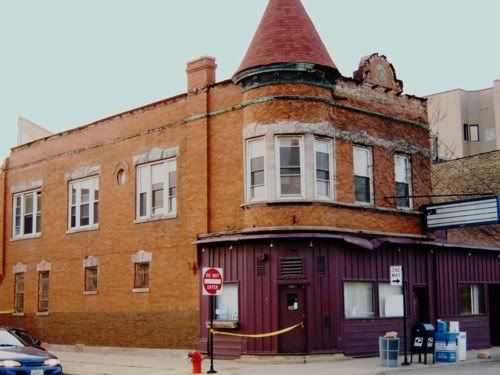
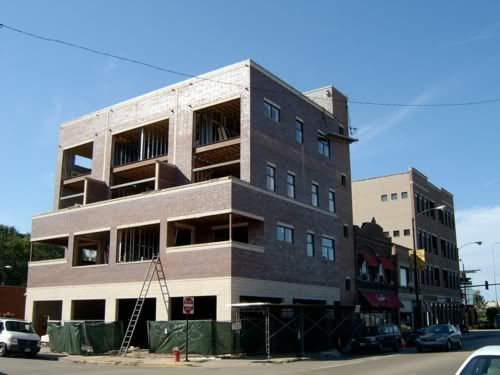
Just a little update on what's been going on with the neighborhood. I've stopped posting pictures of demolished buildings recently because I never seem to have the camera handy. But I thought I'd post a couple bfore and after pictures of some of the sites I've talked about in the past so you can see what's happening to the neighborhood and the new world that's emerging on the Near West Side.

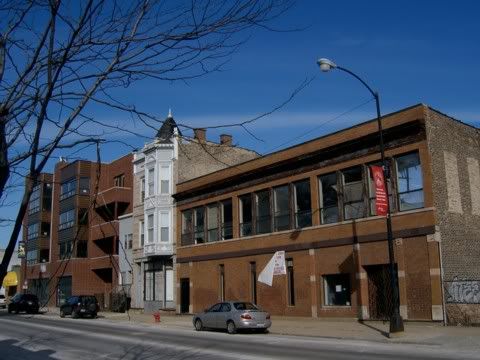
Before
Image hosted by Photobucket.com

This building was a neighborhood landmark and a favorite. It was demolished because it was too small, and didn't feature any condos with balconies like the rich people like. They are willing to accept less footage to be able to live close to cool people like me, but they demand a view.

After
Image hosted by Photobucket.com

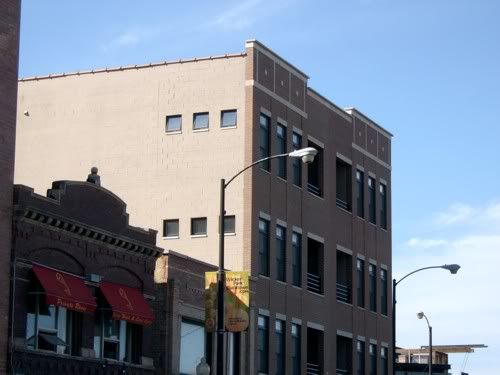
The big problem with this building is that it faces the wrong way. It ignores Damen, Bucktown's main thoroughfare, in favor of Shakespeare, which at a quarter-block south of Webster is not even a real street, since it doesn't fit the grid. From it's balconies, the moneyed classes will be able to gaze south along Damen and see the trendy business district with its boutiques and restaurants and funkily dressed babes, oblivious to the way their homes have deteriorated the quality of life for everyone around them. By facing south, the building presents a side view to Damen Avenue, with little bathroom windows that are asymmetrical, too much empty brick, and the edge of the balconies visible on one side only. In short, it's lopsided, deformed and ugly. The designers apparently decided that if they put retail with an attractive awning on the ground level, nobody will notice how the little group of buildings has become scarred and disfigured.

Image hosted by Photobucket.com

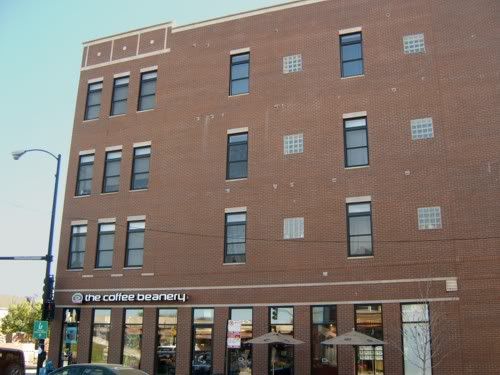
The new condo building at the corner of Damen and Webster, by contrast, faces the right way and even manages to present an attractive and fairly symmetrical face to the residential side street.

Image hosted by Photobucket.com

Before
Image hosted by Photobucket.com

An attractive two-story commercial-residential building with decorative 19th Century iron metal details. Not enough units on the property, once again no balcony for rich people to store their bicycles and gas grills.

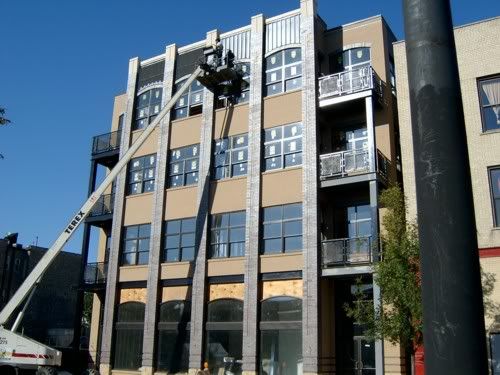
After
Image hosted by Photobucket.com

Fairly attractive modern commercial-residential condo building going up on a portion of the site. This building pays more attention to detail than do most new condos I've seen, the splash of color brightens up what is quickly becoming another shopping/residential quarter. I am pleasantly surprised. An identical building will rise next door, and then a skinny half-building that will look like the right half of this one, on the site ofthe old building. Unfortunately, this four-story complex will pretty much overwhelm the pretty Victorian turret next door.

Still, as industrial uses fade from the area, they are trying to extend the Wicker Park trendiness all the way up to the Congress Theater and beyond. Unfortunately, retail jobs do not pay what industrial jobs did, and people who work in these buildings could never dream of living in them, or increasingly, living in the neighborhood at all. Fortunately there is an El stop a couple blocks NW on Milwaukee.

Image hosted by Photobucket.com

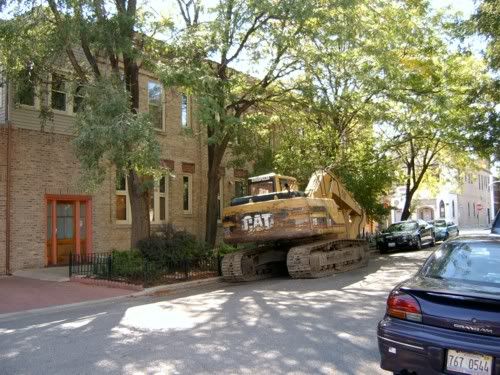
Well, another digger, signifying another teardown is about to take place. I took pictures of all the likely suspects, but I was wrong. A little house that used to be a storefront was the victim. I don't really remember it and I walked by it several times a week for three years, so it's probably not the biggest tragedy ever. Still, I wish these people would leave my neighborhood alone. They are filming a movie here tomorrow so we won't be able to park on our own street. Maybe once people see the 'hood on film, someone (like the Alderman) will conclude it is worth something more than the value of the land underneath it.

Image hosted by Photobucket.com

This doesn't really mean anything, Trope took it and it's just cool (I played with the color a little to make it pop more). If you have any idea what it might represent, drop me a line.

Friday, September 16, 2005

Dogs and cats, living together

Apparently President Bush made a big speech in New Orleans last night during prime time. I wouldn’t know, I don’t watch much prime time TV, especially not when there’s a Cubs game on the radio. Pat and Ron do a pretty good job of explaining what’s going on, so you can get other stuff done while you listen, something you can’t do with the TV guys. Listening to Bush, but contrast, makes me want to throw and smash things. Which, now that I think of it, is exactly the way many Cubs fans are reacting to the game. The game was rained out during the last out of the Cubs’ 6-1 loss to the Cardinals, which rather than regarding as a mercy, fans are viewing as another example of the dreaded Curse. See, the Cubs had just scored one run, and had a couple guys on base, so obviously if it hadn’t rained, they were going to come back dramatically, beat the Cards and get back in the wild card race.

“The Cubs Fan Universe,” as my wife put it last night, is “disconnected from reality.” A prime example of this is the little jingle WGN plays during commercial break, the one that gets stuck in your head for the next couple days: “Everybody loves the Cubs. Every-Body loves the Cubs!” In addition to being an annoying little earworm, it’s obviously untrue. Just the sound of the jingle is enough to get your neighborhood White Sox fan worked up into a foaming lather. Which, now that I think of it, is probably intentional on WGN’s part.

Speaking of the White Sox, the team that spent most of the year as baseball’s best team just lost a series to the Kansas City Royals, universally regarded as baseball’s worst. They have squandered a 15-point lead in the AL Central to just four and a half games ahead of Cleveland, a team they will be playing for six of their remaining 17 games. The Tribune has (gleefully) stopped printing their “magic number,” at least for today.

In another astounding development, the East Village Landmark District is becoming a reality. In spite of the overwhelming presence of neon orange “Stop the Landmark District” signs in neighborhood windows, 53% of property owners voted to approve the district, which covers 195 properties in the heart of the East Ukrainian Village (the quarter mile square boxed in by Ashland, Chicago, Damen and Division). Proponents of the landmarking have been called “cultural elitists.” Early meetings on the subject were marked by complaints about “condo people and their SUVs.”

Well, what of it? Many of the people who live here do so because they like it the way it is, and think it’s better than other places. They don’t want it torn down and replaced by giant, bunker-like condos that look more like the barrier wall in the West Bank than Chicago three-flats. As for people who just moved there in the last couple year because it’s close to the highway, or to work, but would really rather have more room for their SubZero industrial kitchen appliances, they can get in their big, black SUVs with the W04 stickers on the back window and go back to Aurora. As for owners disappointed they won’t be able to cash in as much on the development craze, your desire to make a buck doesn’t give you the right to destroy everything in the neighborhood. But I digress. We won a fight, which makes the world turn upside down.

In more news of a world gone mad, there's the weather. It's cool, cloudy and raining, and the people are ecstatic about it. Our first week of 80 degree plus weather was in April, and over the next five months we have had fewer than 20 cool days, and virtually no rain to speak of. The grass in many neighborhoods hasn't so much turned brown as crumbled into dust and blown away. Add to that the fact that a large proportion of the younger set moved to a colder climate just so they could walk around all day looking cool and brooding in their black leather jackets, and you begin to understand how much five solid months of nice weather has been cramping our style.

Speaking of upside down, there’s the President. I guess in his speech he promised to rebuild New Orleans out of federal money, send cash to displaced workers, and proposed something called the Urban Homesteaders Act, which would give abandoned urban land to low-income people who agreed to build a house there. I’m not sure whether it applies only to New Orleans or to all of our abandoned urban areas, but still – a good idea out of the Bush Administration! And a big government, pro-city idea at that! I think my head’s going to explode.

What’s he going to do next, officiate at a gay wedding in the Rose Garden?

Thursday, September 15, 2005

ripples in the upside down lake of the void

As you’ve probably noticed, I’ve been spending my time doing other things besides blogging over the summer. I’ve done a lot of gardening, I took trips to Wisconsin and Virginia with Trope, saw the Violent Femmes, went to Around the Coyote, a kick ass arts festival . . . It’s been a good coupla months.

I’ve also been fighting off an unhealthy little addiction. I started surfing the net and stumbled upon a website where people come to talk about TV shows. Ordinarily I wouldn’t be interested, because I don’t watch a lot of TV – at least not a lot that’s actually on, rather than on DVD. But this year there’s a show I’m actually interested in, so I started reading the discussion there, and eventually posting some of my thoughts.

Well, okay. I started posting things that I thought would provoke a lot of argument, which they did. But that’s what I do. Professionally, personally, whatever. Provocation is my stock in trade. I’ve recently been seen having a loud argument about terrorism, oppression, and democracy at the Gold Star Inn, during which my lovely wife was afraid we’d come to blows. Actually I was arguing with someone I like and respect, and we parted friends. I think we just missed Jimmy’s.

In any case, addiction. I got to where I was posting a couple times a day or more, when I had better things I could be doing. Like working. The cause was mostly a heated debate on ethics, one worthy of a weeknight at Jimmy’s. At issue were the “ethical issues” involved in the extra judicial execution of an enemy soldier who is trying to defect. Yes, my controversial and provocative position boils down to "murder is bad, so you should only kill people in self defense." But if you read the paper, you're probably aware that there's a certain amount of disagreement on this issue.

Debating it got me to delve deep into why killing is a Bad Thing, which was useful and productive. But it also got me to the point where I really, really wanted to convince people that murder is wrong, which is frankly insane as well as pointless and silly. People on these boards had previously defended a military overthrow of a democratic government, and the torture and killing of another prisoner. They comment how "cool" and "strong" characters are when they take swift, violent action. Didn't I learn anything from the last election?

Apparently not. I ranted on until I got booted off the board, at least temporarily. Which was fair, because they have clearly posted rules, which I broke. I don't like those rules much (I'll get to that in a minute), but that's not really the point. They have to have some rules, and enforce them, it they want to keep it a nice and reasonable place. That's why I was posting there, and not at other places, where the last time I checked, madness reigned. If I weren't so lazy I could start my own board. But I don't really care, so I won't.

The thing I don't like about the rules is you can't really engage someone else's arguments. Reasoning by analogy, trying to restate someone's arguments to clarify them, is considered rude. Unfortunately (from a certain point of view), that's what I was trained to do both as a crisis counselor back in the day, and as a late-night debater at the U of C. So when I finally said stuff that worked, in the sense that it drew out replies that clarified other people's arguments so I could understand their premises, etc. I also got banned for rudeness.

I see where they're coming from, but to me this kind of politeness is a lot like the "fairness" you see from the mainstream media. One 'side' states an opinion, the other 'side' does the same. Without engaging in real dialogue, nobody ever mentions it whan one side is complete horseshit. The right gets away with passing off complete balderdash as fact. Saddam has WHDs. Gay parents are bad for children. On and on and on. What good't the internet if you can't be more participatory than that?

And I was trying to be polite. Here’s what I didn’t say:

What the hell is wrong with people? Here, in this country, with our history and Constitution and all this blabbering about freedom we do on flag holidays, why the hell did only 73% of Americans believe that the kind of abuse that went on at Abu Ghraib was "never justified?" Why do we sit here and allow people, some of them American citizens, to be detained by the government without charge, without showing any evidence to anyone, for years? Why do we tolerate tens of millions of people living in poverty in such a wealthy country? Why do we have a religious leader revered by millions on TV advocating the assassination of a foreign leader. Why did 59 million people vote for this bullshit?

And why, oh why, do we have people who sit up day and night at their keyboards and argue that torture is justified, that a country in crisis can't "afford" democracy, and the killion someone is not only permissable, but necessary, if you suspect, without evidence, that she might, at some point in the future, be a threat. What the hell is wrong with such people? What guilt are they running from that the feel such a need to spend so much time justifying murder, arguing that we owe nothing to anyone but our own, that self-interest and perceived safety justify destroying whatever we fear. What kind of society are we that we produce people so threatened by the idea that a life is a life is a life?

Should I have said that?

No.

Ripples in the upside down lake of the void, is what I should have said.

Let it go already. The whole thing is meaningless and bizarre. It's another fistful of peas that this monkey should let go of. And anyway, antagonizing people by calling them names isn't likely to change anything they think about killing people, other than possibly to start daydreaming about killing me. The thing is, the show was designed to provoke debate on these issues, but at some level it just doesn't work. According to the creators, many of the events in question were written precisely to
embody one of the main allegorical themes of the show, which is the tendency to dehumanize the enemy in times of war. This has been going on since the dawn of time. We convince ourselves that the enemy is somehow less than human, does not value life the way we do or share any of our common values. This enables us to rationalize and justify the terrible things we do to our enemies such as kill and torture them."

But many people are not terribly bothered by dehumanization. They intended to hold up a mirror to our own times and show us our nobility, but also our pigheadedness, our flaws, our failure to understand that there are other perspecives out there besides our own. But people are not necessarily disturbed by what they see. Kick Ass! they say. Woo Hoo!

I’m not sure whether it says more about the moral blindness of the population or the utter irrelevance of artists in the modern world. It’s like Picassos hanging on the walls of banks or corporate office buildings. Are the bankers and businessmen dupes, or was Picasso? He died a rich man, so maybe it's just me that's the idiot. Probably. Perhaps his radicalism was never relevant, and his legacy is just that rich people will pay a big chunk of money for a piece of canvas.

The failure of art to reach people shouldn’t be surprising. Intellectual debate on ethics doesn’t mean much to most people, either. Which is all right. Compassion and humility will steer you the right way nine times out of ten. But how to deal with people when they won’t be guided by those values, that’s where the trouble starts. Frankly, I'm at a loss. With acquaintances and family members, it's often a choice between awkward silence and yelling matches when it comes to the issues of the day. Neither option is very comfortable.

I promise I won't post about anything this geeky for at least a couple months. In the mean time, a new neighborhood paper showed up on my doorstep this afternoon. Check it out.

Wednesday, September 14, 2005

Coyote Beautiful

Over the weekend I finally had the opportunity to do something useful rather than sit around fuming. The City has set up a shelter and service center at Fosco Park for hurricane evacuees from the Gulf Coast. Fosco isn't really a park at all, it's just a fieldhouse that normally offers community activities, basketball and stuff to residents of what used to be the ABLA housing projects (the Jane Addams Houses, Robert H. Brooks Homes and Extension, Loomis Courts, and Grace Abbott Homes). Now the area's one big construction site as ABLA gets replaced by a new mixed-income development called Roosevelt Square. Actually, I'd kinda hoped I might find something I could buy down there, but poking around their site I didn't see much that an ABLA resident, an evacuee, or I could afford and make it work.

Anyway, the fieldhouse is the designated shelter and referral center for people arriving from Louisiana. As of last weekend while I was there, FEMA hadn't got their act together enough to actually send a plane full of people up here yet, but many people have been arriving on their own, to stay with family or to look for a familiar face. I only saw a few dozen cots that looked occupied, mostly people were coming in looking form services from the city, the Salvation Army, or more permanent housing. Most people are quickly referred out to other organizations offering to put people up for a while, since nobody really wants to sleep on a cot, in a gym, in the projects. Obviously Jesse Jackson's people are a big help in that area, as is his protege Rev. Meeks, who manages to be both a state senator and the leader of a mega-church ("The Greatest Church in the World"). I'm not sure which hat he's wearing here, but his flock have been very generous in opening up their homes to the newly dispossessed.

It occurs to me to wonder what's stopping us from mounting such an effort on behalf of the homeless people who wander our alleys every day.

Anyway, I mostly worked with kids, which was nice. Kids are very resilient and these seemed to have come through all the chaos pretty much intact. Their parents, on the other hand, seemed very stressed out. I helped make paper hats and played air hockey while the parents filled out paperwork or just took a nap or whatever. It wasn't much, but it was something, and being constructive tends to soothe my incoherent rage dcwn into a fitfully napping, fuzzy little fire breathing monster. I highly recommend it. If you live in Chicago and want to help, you should call 311.

Later on Saturday the Violent Femmes played a kick ass block party on Division Street east of Damen. Guinness paid for the whole thing, there was beer, oysters, and crab meat. Also there was an awesome local Irish punk band called the Tossers. I have no idea what the occasion was. I was just there because the night before I was playing Trivia at the Riverview and Lowell said it would be cool. And it was.
And Lowell's pretty damn good at trivia. So's my wife.

Suday was Around the Coyote, a huge neighorhood festival of visual arts, theater, music and poetry. There are still a lot of working artists in the neighborhood, mostly painters, and other artists come and set up in the hallways of the Flat Iron studios, the Northwest Tower, and other neighborhood landmarks. Paranoid Girl was there, which was very cool. She asked me to draw a postcard for her collection. She was sort of disappointed that more people weren't doing this, which puzzled me. I was thinking that any weekend where I had perfectly valid reasons to play with crayons two days in a row was a pretty good weekend. Later on I caught some one-acts down at the Chopin Theater, including an interesting piece by a new high school company, and a performance/dance thing called Inventing Eve about women in the Old Testament.

I love this neighborhood, and this town. But recently I see it destroyed again and again in my imagination. I asked some of the emergency workers at the shelter if Chicago has an evacuation plan. They said there was a plan, and they'd recently participated in a drill. But I got the impression that they felt it could have gone a lot better. Chicago has six times as many residents as New Orleans, a million of whom do not have access to a car. How the hell would you evacuate Chicago? Food for thought.