My irregular musings on city life, politics, baseball, roller derby, and whatever happens to be getting my goat today.

Monday, November 14, 2005

Wish I'd Said That . . .

Facemonkey forwarded this gem to me:
The rise of Idiot America is essentially a war on expertise. It's not so much antimodernism or the distrust of intellectual elites that Richard Hofstadter deftly teased out of the national DNA forty years ago. Both of those things are part of it. However, the rise of Idiot America today represents—for profit mainly, but also, and more cynically, for political advantage and in the pursuit of power—the breakdown of a consensus that the pursuit of knowledge is a good. It also represents the ascendancy of the notion that the people whom we should trust the least are the people who best know what they're talking about. In the new media age, everybody is a historian, or a preacher, or a scientist, or a sage. And if everyone is an expert, then nobody is, and the worst thing you can be in a society where everybody is an expert is, well, an actual expert.

In the place of expertise, we have elevated the Gut, and the Gut is a moron, as anyone who has ever tossed a golf club, punched a wall, or kicked an errant lawn mower knows. We occasionally dress up the Gut by calling it "common sense." The president's former advisor on medical ethics regularly refers to the "yuck factor." The Gut is common. It is democratic. It is the roiling repository of dark and ancient fears.

Thanks, man. That brightened my day.

Ranting into the Void

There's been a lot of talk about blogs being the subversive new media, with a new breed of citizen-journalist daring to tell the truth in the face of the corporate media juggernaut. This kind of talk strikes me as mostly bullshit. If you should take anything you read in the paper with a grain of salt, you should take anything you read on the internet with a whole cube, followed by two tylenol and good night's sleep to mull it over. For one thing, people like me don't have time to do much research, we have actual jobs to do. So what you get is mostly uninformed, unreflective ranting, not to say gibberish.

You can't just read this blog, for example, and think you have some idea what's going on in Chicago. In this space I have been recording, intermittantly, the destruction of neighborhood buildings which I felt were beatiful and good and contributed to the city's unique character and personality, to be replaced by a blank, featureless autoscape somewhat resembling a huge suburban apartment complex but louder, and with more traffic. The other week, however, when I was late for an appointment on the South Side and took what I remembered as a short cut, I discovered that I have missed what should have been the story of the last year.

Downtown Englewood is gone.

The area around 63rd and Halsted was once the downtown of one of the first suburbs of Chicago, a working class immigrant community south of the Union Stockyards, where many of its residents worked. By the end of the 19th century Englewood had been annexed to the city proper, and in the first half of the 20th Century its old downtown served as an important commercial strip for the central South Side, which at the time was pretty much the residential and industrial heart of the city. In addition to shopping, the area was home to several theaters where locals could catch both live jazz and "talkies."

After World War II, as discrimitory "housing compacts" were held to be illegal, Chicago's growing African American population began moving west across Cottage Grove and towards Englewood. The idea of racial integration was not viewed in a positive light by the local white community, and in the early 50s a riot famously broke out in the area after the rumor spread that a local man planned to sell his house to a black family (actually, a nosy neighbor had merely observed a black man attending a labor meeting at the house. Rioters burned the house down anyway, or maybe they didn't - we bloggers are not so big on fact checking, remember).

Long story short - as African Americans began to move into the area, virtually every white resident left the community in the course of perhaps years, pretty much one block at a time moving east to west. At first there were enough new residents from the crowded Bronzeville area to buy or rent whatever space opened up, but soon there were more sellers than buyers, property values tanked, and new residents became poorer and poorer (during the period of urban "white flight" the first black families to move into a neighborhood generally had higher incomes than the previous white residents - they could afford to escape the ghetto, but their choices were limited by rampant discrimination by lenders as well as sellers). Soon, the original middle class black settlers, realizing they had been joined in Englewood by the very same ex-neighbors they themselves had been trying to get away from, moved again, this time to the south, leaving Englewood as a segregated community with increasing poverty and a rapidly declining population. Today the neighborhood has less than half the population it did in 1960.

Soon all the businesses around 63rd and Halsted were closed and boarded up with the exception of a liquor store and a drug store, if I remember right. By the time I arrived here a few years ago the abandoned downtown was an honest to God ghost town, with boarded up 19th Century wooden and brick storefronts lining an eerily quiet street, with an impressive and abandoned old bank building and a few other gems. Ironically, the city had hastened the commercial strip's demise by demolishing part of the area to put in parking and routing traffic through a detour to create a "pedestrian mall" - those things almost never work. For years the boarded up district was flanked by taunting signs with arrowd for "Through Traffic" and "Shopping" - hence my old short cut through the ghost town. I used to find reasons to take out of town visitors through the area, just so they could see firsthand exactly what's happening to America's cities. As Juan Cole recently noted in a blog post about the riots in the French banlieu:
(Americans who code themselves as "white" are often surprised to discover that "white people" created the inner cities here by zoning them for settlement by racial "minorities," excluding the minorities from the nicer parts of the cities and from suburbs. As late as the 1960s, many European-Americans were willing to sign a "covenant" not to sell their houses to an African-American, Chinese-American or a Jewish American. In fact, in the US, the suburbs were built, most often with de facto government subsidies in the form of highways and other perquisites, as an explicit means of racial segregation. Spatial segregation protected "white" businesses from competition from minority entrepreneurs, who couldn't open shops outside their ghettos. In France, government inputs were used to create "outer cities," but many of the same forces were at work.)

Couldn't have said it better myself, so I won't try. Anyway, apart from the bank building and a few neighboring structures, the entire 19th Century downtown has been demolished. It's one big, flat construction site today.

Urban historian Max Grinnell tells me the corner of 63rd and Halsted is going to be the location for the new campus of Kennedy-King College. Which brings us to one of the things you haven't heard much about if you're getting your news about what's been called "gentrification" just from bloggers and alterna-rags (you haven't heard me use the dreaded G-word, but people read it into my posts anyway): some neighorhood changes are good, and even necessary. While it pains me that unimaginitive bureaucrats could not find a way to preserve and re-use more of the charming old facades that lined the street, it's hard to argue with the kind of development that will bring students and their spending money, as well as a libraty, bookstore, and swimming pool all open to the public, to a neighborhood that had none of these things. If it's done right, it should create an actual functioning commercial district in an area where for the past 25 years a ghost town has stood.

It's true, based on the execrable design of the other City Colleges I'm scared of what monstrosity may rise there - another cold, uninviting bunker separated from the street by fences, hedges, and expensive, useless little patches of grass will certainly not enourage anyone to stay around and have lunch. But the bones of the old neighborhood - Englewood is very nicely laid out, with above average access to parks and civilized, tree-lined streets, and would be walkable if there were any businesses left to walk to, plus it has it's own El stop, unlike most of the transit-deprived South Side - make me hopeful that the area will recover.

Apartheid was bad for South Africa and it's bad for America today. A little "gentrification" in Englewood would be a very, very good thing.

Thursday, October 27, 2005

Last Thoughts on 35th Street

. . . at least until spring training and the whole cycle of joy and sorrow starts over again.


Winning the World Series is not my dream. It is my goal.
- Ozzie Guillen, a few long, impossible weeks ago.
The White Sox won the World Series. Strange to think about. The Red Sox and their legions of long-suffering fans made sense somehow, and made the world seem right, and good, and orderly. The Cubs? Someday. But the White Sox? This was the team that hadn't won since the 1919 squad threw the series to collect the gambling payoff. In spite of the name, their team color is black. Once they had to forfeit the second game of a double header when fans wouldn't leave the field following a publicity stunt which involved blowing up disco records. For years they've been playing to a half-empty house in a forlorn, cement monolith of a ballpark stuck between the railroad track, the Dan Ryan Expressway, and the Stateway Gardens, Wentworth Gardens, and Robert Taylor housing projects. Suspecting this was the source of their long-standing attendance problems, owner Jerry Reinsdorf tried to move the team to the suburbs in 1988. But after he bought up the land, the suburb of Addison wouldn't take them - residents voted down the stadium proposal, fearing that it would result in drunk people pissing on their well-manicured lawns. (Why is it so boring out there? They like it that way.)

But it wasn't just fear of the neighborhood that kept the crowds away. An Opening Day Ipsos Poll revealed that the cross-town Cubs have approximately five times as many fans as the Pale Hose. In fact, a good number of people at the Cell on any given game day, myself included, are Cubs fans who want to see a game and can't get tickets to perennially sold out Wrigley Field. A World Series title may shift those numbers a bit, but the Sox are still mightily unloved. A loser among losers. The geek the other geeks make fun of. In short, the ultimate underdog. So it does make the heart feel glad, and the burden of life a little easier, to see them win something.

And who did they beat? The Houston Astros. George Bush Sr.'s team. The whitest team in the league: did you know the Astros were the first team to play in the World Series without a single African American player since the 1953 Yankees? (The league was integrated when the Brooklyn Dodgers hired Jackie Robinson in 1947, but the Evil Empire didn't integrate until 1955).

This isn't really the team's fault, it's a symptom of the broad decline of African American ball players over the past 20 years. Inner city kids of they kind who used to dream of playing professional baseball now prefer football and basketball. Brian, the pastor at our Unitarian Church and a diehard Red Sox fan, tells me that part of the problem is the expense of assembling all the equipment for a game of baseball - all you need for a game of football or basketball in the park is a ball. Whatever the reason, his attempts to lure neighborhood kids into forming a team have so far been unsuccessful.

A few generations ago baseball was huge in black communities. A middle aged black professional I work closely with was reminiscing last week about White Sox past. "I remember when they went to the Series in '59, I was in 5th grade. Of course, I was a Dodgers fan. We were all Dodgers fans then, because of Jackie Robinson."

Even before the Dodgers integrated, African American professional baseball was widely followed. Although the numerous attempts to form stable professional leagues were mostly financial failures, a number of teams persisted through the early decades of the 20th Century and managed to play some great baseball. In fact, the White Sox, during the 1950s, shared old Comisky Park with the Chicago American Giants, another great South Side team that was built on speed, pitching and defense. Before that the American Giants played at Shorling Park, which had been home of the White Sox from the 1880s until Comisky was built.

I suppose I had a point when I started writing this post. I can't for the life of me remember what it is now. My mind's getting bleary from daydreams, and lack of sleep, and the several drinks I had with dinner down at the bar. But what I've arrived at is this. Fifty years ago, even with Jim Crow and all the problems this country was facing, African Americans had their own leagues - they owned the teams, played the games, and packed the seats. Today, in many communities the cost of bats, gloves, face masks and helmets is considered prohibitive. Often we tell ourselves that things have been getting better in this country, but that all depends on where you stand.

When I think about Ozzie's statement about winning I think about the state of America, her cities, her progressives. I tried to say this yesterday, but looking back I didn't do such a good job so at the risk of being repetitive:

We do too much dreaming, as well as too much intellectualizing and perfectionist nitpicking. It's time we stopped dreaming, and set some goals, and worked together to achieve them. I hear that sometimes that's all it takes for a bunch of losers and misfits to win it all.

Wednesday, October 26, 2005

a year of living dangerously

WE WON'T THROW THIS ONE
- sign on the marquee of the Shamrock Express, at 110th and Western


It's come to my attention that this blog is just about a year old. It was born a day or so after the 2004 elections, partly in an attempt to explain or at least explore the much discussed Red/Blue cultural divide. My sense was that the essential conflict was not so much between states or classes as between types of communities - dense, diverse places like Chicago in which the attempt to build and sustain community is paramount vs. low-density sprawl and rural areas in which the cult of the radical individual is more important.

I still hold fairly strongly to those ideas, but my thinking has become a lot less simplistic over the past year. So I want to take a look at some exceptions. Do they prove the rule? Who knows.

The other weekend we were on a subway train on our way to 125th Street in Manhattan (yes, music lovers, the A Train to Harlem)when it was boarded by a large group of creepy African American churchgoers, who commenced to start singing hymns. Some of the passengers knew the songs and started to sing along, the others looked uncomfortable. Trope gave me one of her ear bugs and we sat there listening to Ditty Bops MP3s trying to ignore all the Jesus. Then they stopped singing and a preacher lady started talking about how God had destroyed New Orleans because of all the voodoo and homosexuality and it was time to repent.

"Hell no," I failed to say. "Get your ass off this train and go spew your hate in the sewer where it belongs, you nasty old cow," I failed to add. I sat there, heart beating in my ears, blood pressure about to make my eyeballs explode out of my face, paralyzed. I wouldn't (and couldn't) have actually pushed her in front of a train, but if someone else had done so I might just have cheered. The only thing hate begets, evidently, is hate.

If there's a core "problem" with American culture it's our tendency to kick down the ladder. If we need someone to blame, it's far easier for us to blame someone beneath us on the food chain, rather than someone "successful," or god forbid, ourselves. Blame the poor for drowning in a flood, or blame gay people - apparently everything is their fault today. First it was divorce and sex abuse scandals, now even the weather can be blamed on gay people!

Take my favorite bete noir of recent weeks, White Sox fans. While it's true to some extend their bitterness towards North Siders is class based, and thus "progressive," it's expression is usually "cultural" rather than economic. Even within Blue America territory, they vent about "yuppies" and especially about how there is a large gay community surrounding Wrigley Field (overheard at a game: "This one's a Cubs fan and the other one's a Red Sox fan. I should have just dropped them both off at the Man Hole.") What's up with that, anyway? Homosexuals are just one of a crowd of scapegoats I keep hearing about. Working class Americans, rather than uniting against the depredations of Corporate America, tend to blame: welfare moms. Affirmative action giving "their" jobs to minorities. Foreigners: as welcome as Americans' righteous indignation about the Katrina disaster was, you didn't have to listen to people talk about it for long before someone said: "We should stop all foreign aid until we rebuild the Gulf Coast." Because people who drown in Bangladesh are so much less important than we are, right?

We're all like this to some extent. Blue people too. Our country wasn't taken over by a coup or a conspiracy, people chose this. Until we can come to grips with that truth, we'll never change it. And I'm not just talking about voting. We chose this by our lives, by our consumption, by the way we participate in keeping other people down and then justify to ourselves how they brought it on themselves. They didn't finish school, couldn't keep their pants on, did the wrong kind of drugs, whatever. It couldn't be our fault.

Game 3 of the World Series - wow. After 14 innings, the White Sox finally get a couple runs in to win as reliever Ezequiel Astacio collaped. After the game, Astros manager Garner vents to the press about how "pissed off" he is that his team played terrible and wasn't hitting. But none of it was his fault, for not pulling the pitcher, for not calling for a bunt with a guy on third, in short for not doing his job. It was all the people under him, who work for him, what a bunch of losers.

Often I see progressive America behaving exactly like Garner. It ain't us, it must be the refs. The media. Voting machines. The Democratic Party leadership jockeying for the next election. It couldn't be us. We can't even imagine a world in which people might see us as hypocrites.

It's so easy for corporate elites to roll over us time and again in their single-minded pursuit of profits because the rest of the country is a bickering, squabbling mess. Religion, race, and "culture" divide us and keep us down. Some people want to build a progressive movement that's a mirror image of the Right - well-funded, ideological, bent on manipulating the public's understanding of reality rather than understanding it. None of that for me - I'd prefer a team that looked like the White Sox.

As I've noted, it's hard for me to root for them, since their fans express such contempt for my sushi-eating yuppie ass. And it's especially hard when they're playing in Houston and the camera pans across the crowd, zooming in on the disappointed faces of little kids in Astros gear as their team gets beat down, again. But that's not the team's fault, that's just life. And the team is interesting. A minority-led coalition not based in religion or language, but unified by a goal. They let each other off the hook when they make mistakes and present a common public face. They laugh, and do belly flops on the tarp when it rains. They like themselves, but take responsibility when their screw-ups cost the group. They bring crippled old Frank Thomas along for the ride even though he can't play anymore.

What's with all the sports metaphors? It's all about achieving a goal. In baseball, the goal is totally inconsequential and arbitrary - nobody really cares what happens to the little white ball, so the whole thing can be about process.

American Progressives don't have a goal these days. Everybody knows what the Right wants - a dog eat dog libertarian world with a veneer of religious and cultural bullshit to explain to the little dogs why they deserve to get eaten. But what's our goal? What does our America look like? We need to stop complaining about how bad things are and start talking about how great they can be if we pull together and try to accomplish something.

Tuesday, October 18, 2005

Demolition of the Week: Chez Roberta

Image hosted by Photobucket.com
Roberta's house on Webster, last December

Well, our house has been more or less patched together, but the rest of the neighborhood continues to disappear one building at a time.

The most recent loss was, in my opinion, a real classic. The house at the northwest corner of Webster and Hoyne appears to have been built as an apartment building, but it has spent the past few decades as a single family home. Roberta, a friend from Tai Chi who lived there until a year or so ago, grew up there with her parents and 12 brothers and sisters. The family bought the house back in the 1950s when they moved to Chicago from South Dakota - recently her parents retired for good and decided to go back to their hometown in the Badlands.

The developers simply offered them too much money to turn down, and never hid the fact that they planned to demolish the property as soon as they sweet-talked the alderman into changing the zoning. Because the house had a small "yard," a small empty corner lot next door, they knew they'd have room to build something a millionaire could love.

Image hosted by Photobucket.com
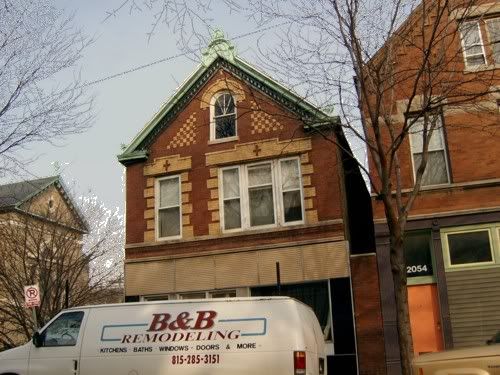
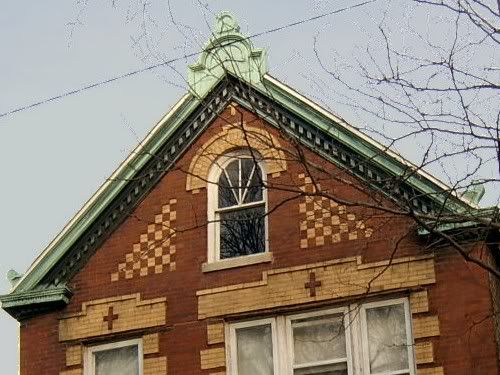
The house was a great example of how attention to decorative detail in a structure can contribute to the neighborhood.

I really liked this one. It was part of a group of buildings that complemented each other and helped establish the neighborhood's character right away as you entered it, walking or driving west on Webster. The whole northeast frontier of Bucktown has been gradually disappearing, being replaced by a generic hodge podge that nobody will really care about, not even the people who live there.

When you add in the fact that a bunch of guys from the gas company just ripped up my impatiens with a back hoe, the neighborhood just doesn't have the charm it did even a week ago.

Thursday, October 13, 2005

The Joys and Sorrows of a 115 Year Old House

So we got back from Ohio on monday and smelled gas as soon as we walked in the door. Trope summoned a guy from the gas company, a nice enough guy, sort of a young black Santa Claus. Santa told us that the line carrying gas in from the street was leaking, and he'd have to shut off the gas to the house until our landlord got it fixed. Also, there was no shutoff valve in the house, so some guys would have to come out, right away, and tear up the front yard to disconnect the gas by, like, smashing the pipe with a backhoe. You couldn't make this stuff up. Using a little clicking device that reminded me of the jury-rigged motion detectors from "Alien," Santa determined that the line in question runs right through the bedroom, and our closets, to the meter at the back of the house. The leak is somewhere south of the stairwell, meaning that a sizeable chunk of wall or ceiling will have to be removed to get at the pipe in question in order to repair it.

So the landlord dispatches a guy he knows who can allegedly fix the pipes. Call him Manny Ramirez. Manny's plan is to remove the gas meter and attach a tank of pressurized CO2 to the gas line, repressurizing it and inspecting it to find the leak. Only it won't repressurize, because the end that's outside isn't really shut off, it's just been smashed by a backhoe. Manny takes off to Home Depot to buy something to plug the hole with, and never comes back.

The next morning Manny's back a little after eight. He borrows my shovel and starts digging around in the big muddy pit the gas company dug for us. Did I mention that they covered it with wooden skids they stole from a nearby construction site? No? Now how could that have slipped my mind?

Anyway, Manny can't fix the pipe because the whole thing is crumbling to the touch now. He says it's original to the house, which is a little scary because the house is a little worker's cottage built in 1890. Apparently in all that time nobody's tried to shut the gas off before and realized that it couldn't be done. In any case, it now looks like the gas company needs to tear up the street, and we need to tear out our ceilings etc. if we ever want to spoil ourselves with hot water again.

I've never been so glad for our gym membership - at least I have somewhere to take a hot shower every morning. But I'm going to start getting testy if I can't cook something soon. And Trope has this thing where she believes that disease is caused by fanciful, invisibly small creatures called "germs" rather than enemy witch doctors, and she tends to like things to get washed in painfully hot water, which is supposed to melt these germs like the witch in "Wizard of Oz." But of course we don't have any of that here.

So we're going to do what any sensible person would do - flee to New York for a few days, and hope we have gas service by the time we get back. If not, we can always break out our terrorist incident emergency stash of MREs. Nutrition: A Force Multiplier!

See ya next week.

Thursday, October 06, 2005

Johnny Saves

I can’t do it.

I can’t root for the White Sox. Not yet, anyway.

I know the arguments on the other side: they’re the best hope for a title-starved town, while Boston has already won their Series at last. And the White Sox are probably the better all-around team, so in some sense they “deserve” to win.

But I just don’t care. And I think a lot of people around town are having the same experience. If you have been watching the media recently, you’d thing Chicago has been swept with a wave of Sox fever, but it’s just not true. Most Chicagoans regard the success or failure of their redheaded stepchild baseball team as irrelevant to their own happiness and well-being. And why should they?

For that matter, why should they care about any sports team? I grew up with baseball, more or less. As we bounced from city to city in my youth, we never really stayed faithful to a baseball team, although my father continued, mostly fruitlessly, to root for the Chicago Bears, which taught me something about humility and identification with the underdog. But when we moved to the Cincinnati area when I was, my father embraced the community wholeheartedly for some reason, and soon we were all pulling for the Bengals and the Reds, two teams that were much better back then than they have been recently.

Summer vacation in those days was embodied by the Reds game on the radio, my father grilling spareribs on the back porch. And, of course, the inevitable end-of-season letdown. I didn’t care that much about the team either way, but trips to Riverfront Coliseum were a treat, what with the junk food, the crowds, and the cool skybridge connecting my father’s office building with the ballpark. That ugly, ugly ballpark has since been replaced by a newer, more intimate field, but I can still see the raw concrete and smell the crowd. In 1990, the Reds led the division from wire to wire and rolled on to the Series. I was too busy starting college, falling in love and getting political to pay too much attention to late season baseball, but I did catch most of the Reds’ four game sweep in the basement of a frat house that was trying to recruit me by plying me with free beer.

A few years later came the strike – the World Series cancelled over a labor dispute? Players and owners both became warring tribes of annoying rich people who cared more about getting richer than they did about the game or the fans. Why did we care about those people anyway? In and of itself baseball is a sublime and beautiful thing, but I’d always been suspicious of fan identification – if you’re not on the team yourself, why does it matter to you which team wins? Most fans are just “rooting for laundry” anyway – backing whoever wears the uniform, not because of who they are, but because of the name of the city scrawled on their jersey (and teams should play for cities, dammit, not states. None of this “Utah,” “Texas,” “Florida” or “Arizona” crap. Not to mention “New England.”) The strike brought this suspicion home to roost. These people didn’t care about us. What fools we were to care about them. I don’t think I watched a single game for the next five years. I ignored the dominance of the evil corporate Yankees in the post-strike era, only paying attention for the Indians’ brief, futile title run, and then only because my ex-girlfriend’s family were such big fans, I sort of hoped on their behalf that the would win. But the Indians, another of the great, hexed teams, ended up losing (Besides the Curse of the Bambino, there is of course Sam Sianis’ goat keeping the Cubs down, the Indians were cursed by the members of the American Indian Movement over their offensive mascot, Chief Wahoo, and of course the White Sox haven’t won since the Black Sox Scandal of 1919, in which the team threw the Series after being paid off by gamblers.)

Then came the post-9/11 era, and the Idiot Mob’s determination to circle their wagons as a response to the attacks. Not only did they decide to rally around the flag and “God Bless America,” (Irving Berlin! So much catchier than the official anthem), they rallied around their loathsome President, and more shocking still, around the New York Yankees. Now I love New York as much as anybody and more than most, and I was deeply affected and horrified by what had happened. But I’m not going to root for the Evil Empire. The Fightin’ Plutocrats are a travesty, an offense against fair play and competition. A $200 million dollar stacked deck. The attempt of a billionaire madman’s ego to buy the championship year after year after year. They were going for their 27th title in 97 tries, and almost the whole country was rallying behind them.

Not me, baby. George Steinbrenner does not need my support. I ended up getting behind a team I had never heard of, a team I swear hadn’t heard of the last time I paid any attention, the Arizona Diamondbacks. Did I mention how annoying I find it when they name teams after states or regions rather than towns? Still, the Diamondbacks were the last thing standing between the Evil Empire and world domination – and all they had were two pitchers named Kurt Schilling and Randy Johnson. I was hooked. They held on through a full seven games, and in the end they beat back the forces of darkness.

Since then, I care about baseball, especially our lovable losers of Lakeview, the Chicago Cubs. They may not always play well, but they play for us. The “tax-hiking, government-expanding, latte-drinking, Sushi-eating, Volvo-driving, New York Times-reading, body-piercing, Hollywood-loving, left-wing freak show” we call Chicago. I think I never understood why people identify with a team before because I’ve never identified with a community. Now that I have a home, I care about it a great deal, and identify with it.

Which is why I can’t get excited about the White Sox. It’s nothing against the team, who are great at what they do. And Ozzie Guillen is always amusing when he tries to talk to the media. But the fans, well, they ain’t us. In fact, the White Sox fans seem to define themselves as “not Cubs fans.” Even now, in the postseason when the team has other teams to worry about, the fans are focused on the Cubs. On my trips to the Cell the past couple days I’ve seen T Shirts and chants of “Cubs suck.” Jokes about dropping friends who are Cubs and Red Sox fans off at the Man Hole, a bar in the predominantly gay neighborhood surrounding Wrigley field. They call us “wine drinkers,” even though wine is for sale at the Cell, while Wrigley sells only beer as far as I know. There’s a cultural fault line here, one that should be familiar to anyone who has read “What’s the Matter with Kansas.” But why should such a rift occur in sky-Blue Chicago, Illinois?

A glance around the Cell on game day reveals a very white crowd, my hulking but friendly tattooed Mexican neighbors for Game 1 aside. This light complexion is striking because the South Side of Chicago is 77% minority, a patchwork of African American and Latino neighborhoods interspersed with a shrinking number of white enclaves on the far Southeast and Southwest sides – and, of course, Chinatown. The Sox themselves are a mix of black and Latin players with a couple of Polish guys and some newcomers from Asia, not so different form the neighborhoods surrounding the ballpark. But the fans? In the stands, anyway, many of them seemed to be descended from the old Irish South Side, today living mostly in the south suburbs since their families abandoned the city in droves in the 70s and 80s rather than live next door to black people. There were a lot of handmade shamrock-adorned “Southside” posters in evidence, at any rate. “Southside” is a state of mind, I guess, a mythical place encompassing the lives and beliefs of neighborhoods throughout the South Side and south suburbs, an attitude more than a real place, a strange amalgam of what was and what might have been. From what I can tell from having lived and worked on the South Side, the actual population there is divided evenly between indifference, Sox fans and Cubs fans. But the real South Side is not the point. Bitterness towards the perceived elite is the point. It seems that regret and shame over what has happened to their communities and envy towards our more engaging lives can both but sublimated into anger and contempt directed at people like me. So we can’t get on a “Sox bandwagon” because we’re not invited. Anyway, as an ESPN radio announcer explained the other day, “there is no Sox bandwagon. That’s the whole point of the White Sox.” If y’all actually enjoy playing the role of ostracized, victimized loser, then more power to you.

This is exactly the kind of ‘false consciousness” that people use to keep themselves down. Compare this false populism of White Sox fans with the broad, community-based authentic populism of Red Sox fans. In the Red Sox cult, everyone from Maine farmers to Boston city slickers to blue collar guys from Lowell are bonded together in the shared experience of human suffering and loss. While the generations-long talk of a “curse” was pretty bogus, the game does teach something about suffering and struggle, inevitability and chance. While you can defy the odds for one day, or one play, in the end the game is about averages – winning percentages, batting averages, earned run averages – and a manager’s job is to line up the numbers just right. So year after year, fans hoped for a miracle, but year after year the numbers didn’t lie. Physics guides the ball, probability guides player performance, reaction inevitably follows action, and the Red Sox lost. Last year, when the finally deviated from the mean enough to win, they gave me something I didn’t know I could still feel – hope. Wonder, awe, and hope.

It’s kind of like my relationship to life, death, and faith. I know what goes up must come down. I know we are all born to die. I know that, over the long term, we are all doomed to war, disease, death. But part of me continues to hold out hope that maybe, somehow, there could be something else. If not immortality, then meaning. Participation in eternity. Hope.

So I can’t root for the White Sox. Not yet. I know they have the better team, the better pitching rotation, and are almost certain to get the one win out of three chances they need to advance to the ALCS. The numbers don’t lie, match the pitchers’ past performance against the hitters and you get a high probability of a Southside sweep. But I’m still hoping for a miracle.

Of course, if they do advance, I’ll be pulling for them against the Yankees next week. Because beating Team Evil is what baseball is all about.