They're telling the people they have to go. They're going door to door with rifles now.
They came to our little hovel on Laurel Street Uptown - a dozen heavily-armed members of the California National Guard - they pounded on our door and wanted to know who we were.
We told them we were the newspaper, the Big City Daily. I admit, it doesn't look like the newsrooms you see on TV. I suppose if we wore shirts, we'd look more professional.
The Guard moved on, next door, next block.
They're telling people they have to go.
It won't be easy. The people who stayed here have weathered 10 days of unfathomable stench and fear and if they haven't left yet, it seems unlikely that they're going to be willing now.
In a strange way, life just goes on for the remaining. In the dark and fetid Winn-Dixie on Tchoupitoulas, an old woman I passed in the pet food aisle was wearing a house frock and puffy slippers and she just looked at me as she pushed her cart by and said: "How you doin', baby?"
Like it's just another afternoon making groceries.
I love the way strangers call you baby in this town.
Outside the store, there's an old guy who parks his old groaning car by the front door from sunup to sundown. There are extension cords running from his trunk into the store, which still has power - don't ask me how; I have no idea - and he watches TV in his front seat and drinks juice.
That is what he does, all day, every day.
At this point, I just can't see this guy leaving. I don't imagine he has anyplace else in the world but this.
A young guy walked up and said to him: "I hear you can charge your cell phone here?" and the old guy said "Yes, indeedy," and walked him into the store and showed him a plug that still had juice.
And life goes on. Down on St. Claude Avenue, a tribe of survivors has blossomed at Kajun's Pub where, incredibly, they have cold beer and cigarettes and a stereo playing Elvis and you'd think everything was in standard operating procedure but it is not: The Saturday night karaoke has been indefinitely suspended.
The people here have a touch of Mad Max syndrome; they're using an old blue Cadillac for errands and when parts fall off of it - and many parts have fallen off - they just throw them in the trunk.
Melvin, a bar owner from down the block, had the thing up for sale for $895, but he'll probably take the best offer now.
Melvin's Bar and Kajun's Pub have pooled their inventories to stay in business.
"We've blended our fortunes together," said Renee dePnthieux, a bartender at Melvin's. "We carried everything we could down here, and we'll make the accounting later. What else are you gonna do? In case you haven't heard, Budweiser ain't delivering."
A guy with a long goatee and multiple tattoos was covering a couple of aluminum foil pans of lasagna and carrying them up to the roof to cook them in the sun on the hot slate shingles.
Joann Guidos, the proprietor at Kajun's, called out for a game of bourre and they all dumped their money on a table and sat down and let the cards and liquor flow.
A National Guard truck pulled up and asked if they were ready to leave yet. Two guys standing out on the sidewalk in the company of pit bulls said: "Hell no."
DePonthiux said: "We're the last fort on the edge of the wilderness. My family's been in exile for 300 years; this ain't s---."
I just don't see these people leaving.
Uptown, on what was once a shady street, a tribe is living in a beautiful home owned by a guy named Peanut. There is a seaplane in his driveway, a bass boat in the front yard and generators running the power.
Let's just say they were prepared.
All the men wear pistols in visible holsters. They've got the only manicured lawn in the city. What else is there to do all afternoon, really?
Christine Paternostro is a member of this tribe and she is an out-of-work hair stylist from Supercuts in a city where no one shaves or bathes. Not many prospects for her at this point.
"Everyone will need a haircut when this is over," I offered.
While members of this tribe stood talking on their street, a woman came running out of the house, yelling: "Y'all, come quick. We on WWL! We on WWL!"
Everyone ran in the house and watched a segment about how people are surviving in the city. And these guys are doing just that. (Although I think the airplane in the driveway is a little over the top.)
As I was leaving, the WWL woman said to me: "Are you staying for dinner?"
I was not, but I asked what they were having. "Tuna steaks," she said. "Grilled."
If and when they rebuild this city and we all get to come home, I want to live near people like this. I just can't imagine them ever leaving.
They make me wonder if I ever could.
To contact Chris Rose, e-mail noroses@bellsouth.net, or call (504) 352-2535.
Thursday, September 08, 2005
The last, hard core hunker down in surreal city
Chris Rose, from the news blog at nola.com:


Wednesday, September 07, 2005
Lake George
The one thing all of the Bush Administration's failures have in common is that they just don't give a crap about people like us. Regular people, stripped of their retirement, send to die in the Middle East, or left to drown or starve in their flooded homes, all for the same reason.
Conservative ideologues like the guys who run the Bush Administration just don't want to admit that government can do any good in society. Why? Because they're rich, so they want to end the redistributive function of government - they don't want rich people like themselves to have to pay for any services for the not rich. They want people to get what they pay for out of government services, which means that the poor, who can't afford to pay for anything, don't get anything.
Their approach to Social Security is a good example. Basically, their plan is to take the risk-pooling social insurance function out of Social Security, turning it into an investment in which you receive a return on what you put in. The problem with this is, of course, if you're not one of the lucky ones who can put a lot in, you're return will probably be small or run out before you die, meaning the program will no longer function as a solution for the problem of poor people living in poverty.
The disastrous response to hurricane Katrina is the result of the same ideological thinking. Basically, the conservative argument is that it's not government's role to take care of people in need, it's their responsibility to take care of themselves. If government action is warranted at all, it's warrented at the local level.
Now, it should be obvious that poor families are not really capable of protecting themselves from a deadly hurricane. But the same is actually true of local government. Like most big cities in today's America, New Orleans is actually quite poor. That's because most of the white middle class has fled to the suburbs, where they can hoard their tax money for their own, better school districts and such while leaving lower-income African Americans to fend for themselves. Again, the goal isn't really to give people more control over government, it's to prevent the redistribution of resources from one group to another. In other words, to make sure the rich stay rich, and the poor stay poor. Add to this the fact that the two states hardest hit by the hurricane, Louisiana and Mississippi, are also quite poor compared to most states, and quite unable to guarantee an adequate level of services to all of their residents, and you see that any attempt to protect their citizens organized and funded only at the state and local level is doomed to failure.
If George Bush represents anyone in this country, it's big corporations and well to do suburbanites. His goal has been to allow them to hoard as many resources to themselves as possible, by minimizing the amount redistributed to the less fortunate through taxes and government spending. How ironic that he has drawn so much of his political support from regions in the American South filled with precisely the kind of working-class folk he's been so determined to dick over. Maybe that will change someday. Survivors and rescue workers have nicknamed the new body of water submerging much of the Gulf Coast "Lake George" after the do-nothing president who stood by and watched as so many died there.
In Monday's Tribune, Dennis Byrne argues that
Some other random notes on the disaster
I am dismayed to hear so many otherwise intelligent people immediately start declaring that all foreign aid should end because we have our own problems now. The fact is, aid like that we gave to Asia after the tsunami builds up a great deal of goodwill around the world. And we're getting paid back - many countries around the world have offered aid to Katrina's victims, both in money and personnel. Even ostensible enemies such as Iran have offered to help. After all, we helped them after the 2003 earthquake in Bam, disregarding the bad blood that lingers between our two countries.
There's been a lot of discussion about the wisdom of too much development in vulnerable coastal areas. In 1960, there were 180 people per square mile in the coastal United States; by 1994, there were 275 per square mile. And Michael Powell and Michael Grunwald point out in the Washington Post
So even suggesting that overdevelopment might be a bad idea is enough to get you blacklisted. Personally I think that the lure of the ocean is too overwhelming for government policy to effect it too much. But in terms of spending public resources, shouldn't our focus be on shoring up and protectin existing communities rather than subsidizing the construction of new ones?
This blog entry on the history of New Orleans is too cool to describe. You should just read it.
Louisiana and Mississippi Guardsmen whose homes have been destroyed in the disaster are being reassured that their families will be guaranteed housing at Fort Polk, if they choose to remain on active duty or enlist in the regular Army. How's that for a novel way to improve recruiting?
Conservative ideologues like the guys who run the Bush Administration just don't want to admit that government can do any good in society. Why? Because they're rich, so they want to end the redistributive function of government - they don't want rich people like themselves to have to pay for any services for the not rich. They want people to get what they pay for out of government services, which means that the poor, who can't afford to pay for anything, don't get anything.
Their approach to Social Security is a good example. Basically, their plan is to take the risk-pooling social insurance function out of Social Security, turning it into an investment in which you receive a return on what you put in. The problem with this is, of course, if you're not one of the lucky ones who can put a lot in, you're return will probably be small or run out before you die, meaning the program will no longer function as a solution for the problem of poor people living in poverty.
The disastrous response to hurricane Katrina is the result of the same ideological thinking. Basically, the conservative argument is that it's not government's role to take care of people in need, it's their responsibility to take care of themselves. If government action is warranted at all, it's warrented at the local level.
Now, it should be obvious that poor families are not really capable of protecting themselves from a deadly hurricane. But the same is actually true of local government. Like most big cities in today's America, New Orleans is actually quite poor. That's because most of the white middle class has fled to the suburbs, where they can hoard their tax money for their own, better school districts and such while leaving lower-income African Americans to fend for themselves. Again, the goal isn't really to give people more control over government, it's to prevent the redistribution of resources from one group to another. In other words, to make sure the rich stay rich, and the poor stay poor. Add to this the fact that the two states hardest hit by the hurricane, Louisiana and Mississippi, are also quite poor compared to most states, and quite unable to guarantee an adequate level of services to all of their residents, and you see that any attempt to protect their citizens organized and funded only at the state and local level is doomed to failure.
If George Bush represents anyone in this country, it's big corporations and well to do suburbanites. His goal has been to allow them to hoard as many resources to themselves as possible, by minimizing the amount redistributed to the less fortunate through taxes and government spending. How ironic that he has drawn so much of his political support from regions in the American South filled with precisely the kind of working-class folk he's been so determined to dick over. Maybe that will change someday. Survivors and rescue workers have nicknamed the new body of water submerging much of the Gulf Coast "Lake George" after the do-nothing president who stood by and watched as so many died there.
In Monday's Tribune, Dennis Byrne argues that
Maybe the finger-pointing comes from today's mindset that someone else always must be ready and in charge of ensuring our safety and comfort. Or from an arrogance that we can plan in advance for every imaginable catastrophe."It's your own responsibility to save your own ass. There's nothing the government could possibly do to protect its citizens from natural disaster." It's exactly the kind of argument you'd make, if your top priority was reducing taxes on the wealthy, rather than building a better society for everyone. The sad thing is that so many people who aren't rich, have bought into this crap.
Some other random notes on the disaster
I am dismayed to hear so many otherwise intelligent people immediately start declaring that all foreign aid should end because we have our own problems now. The fact is, aid like that we gave to Asia after the tsunami builds up a great deal of goodwill around the world. And we're getting paid back - many countries around the world have offered aid to Katrina's victims, both in money and personnel. Even ostensible enemies such as Iran have offered to help. After all, we helped them after the 2003 earthquake in Bam, disregarding the bad blood that lingers between our two countries.
There's been a lot of discussion about the wisdom of too much development in vulnerable coastal areas. In 1960, there were 180 people per square mile in the coastal United States; by 1994, there were 275 per square mile. And Michael Powell and Michael Grunwald point out in the Washington Post
In 1998, Deputy Assistant Army Secretary Michael L. Davis tried to stop the Army Corps of Engineers from rubber-stamping casino applications without studying the impact dredging would have on marshes that shelter wildlife, purify drinking water and help prevent flooding. This angered Lott, then Senate majority leader, who had recently flown to Las Vegas in a casino executive's jet and had raised $100,000 for Republicans at a casino-industry fundraiser.
Lott got the moratorium lifted, then he got the Army to launch an investigation of Davis. No wrongdoing was found, but Davis was removed from Gulf Coast permitting issues.
So even suggesting that overdevelopment might be a bad idea is enough to get you blacklisted. Personally I think that the lure of the ocean is too overwhelming for government policy to effect it too much. But in terms of spending public resources, shouldn't our focus be on shoring up and protectin existing communities rather than subsidizing the construction of new ones?
This blog entry on the history of New Orleans is too cool to describe. You should just read it.
Louisiana and Mississippi Guardsmen whose homes have been destroyed in the disaster are being reassured that their families will be guaranteed housing at Fort Polk, if they choose to remain on active duty or enlist in the regular Army. How's that for a novel way to improve recruiting?
Friday, September 02, 2005
When the Levee Breaks

For anybody who was worried, Fats Domino has been found alive and safe. But the rest of the news is bad, as New Orleans and the rest of the Gulf Coast has spiraled downwards into anarchy, violence and despair.
The death toll is unknown as decaying corpses are shoved aside by rescuers still trying to reach survivors stranded by floodwaters. Conditions are grim even for those who have managed to make it to shelter. For some reason the government had been unable to get food and water to refugees gathered at the Convention Center in downtown New Orleans by this morning. People are dying of heat stroke and dehydration as they wait in line for a seat on a bus out of town. Their bodies are left on the curb or tossed in dumpsters. In Gulfport, Mississippi, National Guard troops arrived with truckloads of water and MREs to find that no one was there to meet them and no system of distribution had been put in place. The situation is the same throughout the affected area - there is no plan in place, no one is in charge, there are not enough supplies, there is public disorder, hopelessness, desperation, death.
It's not as if the disaster comes as a complete surprise. People have been warning of the looming danger to New Orleans and the region for years. As Paul Krugman puts it in the New York Times:
Before 9/11 the Federal Emergency Management Agency listed the three most likely catastrophic disasters facing America: a terrorist attack on New York, a major earthquake in San Francisco and a hurricane strike on New Orleans. "The New Orleans hurricane scenario," The Houston Chronicle wrote in December 2001, "may be the deadliest of all." It described a potential catastrophe very much like the one now happening.
So why was nothing done about it? I'm not even talking about the long and expensive process of improving New Orleans' defenses against natural disaster. I'm just talking about putting in place a plan to deal with disaster, including a comprehensive evacuation plan to be put in place before the storm hit. It was clear by Thursday or Friday of last week that large-scale disaster was possible. Why wasn't the National Guard called up last week to assist in the evacuation? Not to mention that a third of the Louisiana Guard is in Iraq, along with much of their watercraft. Authorities ordered a mandatory evacuation of the area but did not organize transit for poor residents without cars. FEMA rejected a plan to buy a sizable piece of land and prepare for the construction of a tent city for refugees in just this sort of situation because, in the words of one administrator, "Americans don't live in tents."
Why is this happening? Because we have a government and ruling party that believe that a strong state is not necessary to provide support and assistance to the poor and disadvantaged. They believe that low taxes and less government "interference" will allow citizens to take care of their own needs. The whole idea is ridiculous. No individual can weather a storm of this magnitude alone. Societies overcome these traumatic events by banding together, working as a team, and organizing. Our leaders are not there to lower the state's "burden" on wealthy and privileged individuals. They are there to organize the resources of state and society to serve the public. That's their job. And they didn't do it.
But not only does our national "leadership" not take responsibility for their failure, they instead appear to blame the victims. Illinois' own Speaker Denny Hastert remarked to the Daily Herald of Arlington Heights, Ill., that it makes no sense to rebuild New Orleans where it is. "It looks like a lot of that place could be bulldozed," he said. The Waterbury, Connecticut Republican-American goes further, suggesting that it's a waste of taxpayer money to rebuild a city below sea level. It's true that the sprawling of the American public accross former wetlands, into areas with no local water supply, and so on is inviting all sorts of evironment problems of potentially catastrophic proportions. But that's not what has happened in New Orleans, which has long been one of the jewels of American civilization, mired though it has been in recent decades in the poverty and abandonment that have afflicted many of our urban centers as wealth whites have moved away to avoid paying their taxes. And there's the true cause of the disaster - a nation which, once again, has refused to supply the basics of shelter, food, public health and safety to its poorest residents.
Music: When the Levee Breaks, Led Zeppelin. "It's got what it takes to make a modern man leave his home . . . "
Mood: Angry
Thursday, September 01, 2005
Fats Domino is Missing

I still have few words for all the tragedy and horror of the past few days, but if there's one story in particular that's caught my attention today it's that rock'n'roll legend Fats Domino is missing. The 77-year old musician was last heard from on Sunday night, when he said he planned to ride out the hurricane in his 9th Ward home. As most of you probably know by now, New Orleans' lowlying 9th Ward has been flooded, covered by as much as 12 feet of water the past couple days, with potentially many people trapped on rooftops or in attics, with no food or potable water. Of course, almost nobody's been heard from for days, since all telephone and broadband service, as well as electricity, has been down for days at this point.

Send Help
American Red Cross
P.O. Box 37243
Washington, D.C. 20013
Tuesday, August 30, 2005
The Fall of New Orleans?
Up here we feel a bond with our older sister to the South. Legend has it that it started with Louis Armstrong, tired of the racist Jim Crow South, getting on a train in New Orleans and riding it to the end of the line, at Chicago. He was followed by wave after wave of migrants from the Delta, usually getting off at the old 63rd Street Station (nothing there but a church parking lot now). They brought with them the religion, food, dialect, and most famously music which came to define so much of what 20th Century Chicago. Passenger rail isn't so important anymore, but the railroad still forms a kind of steel umbilical cord tying Chicago to a region millions of its residents or their ancestors once called home.
A region which is currently enduring what must be the worst natural disaster this country has seen in my lifetime. Whole towns have been destroyed. Dozens, if not hundreds, of people have died. And our sister city to the South? Floodwaters laid seige last night, but her walls held for a time, even as the highway bridges spanning Lake Pontchartrain were swept away. But this morning the levees broke in three places, and most of the city is now underwater as the Army Corps of Engineers desperately struggle to full the gaps. At this point it's unclear what will remain of our beautiful sister, but it's clear the loss of life could be severe. We're not even dealing with dead bodies," Mayor Ray Nagin said. "They're just pushing them on the side."
I really have nothing insightful to add to all the horrible news you've doubtless already heard today, but it's on my mind and I felt like I had to say something on the day New Orleans fell. I haven't been there in years, not since my high school marching band joined a few Mardi Gras parades when I was 15, but it sure left an impression.
Wells, I hope you took pictures.
If I hear about anything we could do to help, I will post it here.
Tuesday, August 23, 2005
Rumors of my death have been greatly exaggerated
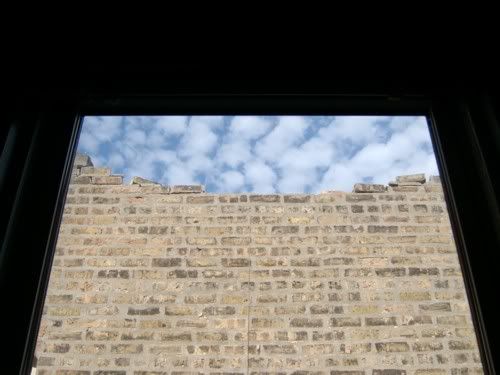
Air show this weekend. We didn’t go this year (not in the mood for militarism) but you could hear the blasting jet engines all over time. The sound reminds me of the days after 9/11 when all civilian flights were grounded and NATO fighters were patrolling the skies over Chicago.
We watched the disaster unfold on television in a friend’s seventh floor apartment in Hyde Park. When the first fighter planes cruised overhead, she yelled OH MY GOD THEY”RE COMING!!! And hit the floor. No, it wasn’t funny later, it was funny right the fuck then, you could feel the tension breaking like ice snapping in a glass of gin.
Anyway, I haven’t been writing lately. For one thing, much of the interesting stuff that’s gone on in the last couple weeks has been at work, and I just won’t blog about that. It would be damned unprofessional. But it leaves me drained, and it’s hard to find the energy to talk about other things.
Big things are up in the neighborhood. Developers’ minions have torn down the apartment building next door and are pouring the foundation for a new one, all without the benefit of a valid city permit!
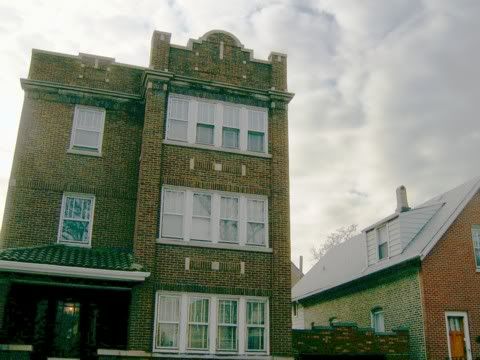
The street that was . . .
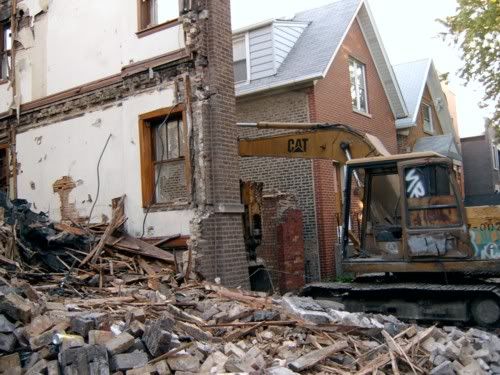
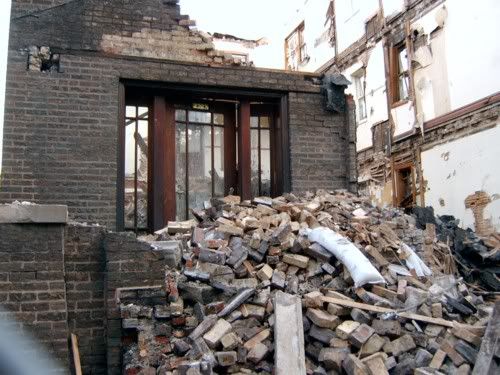
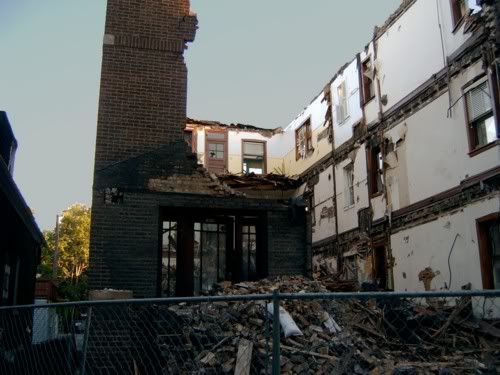
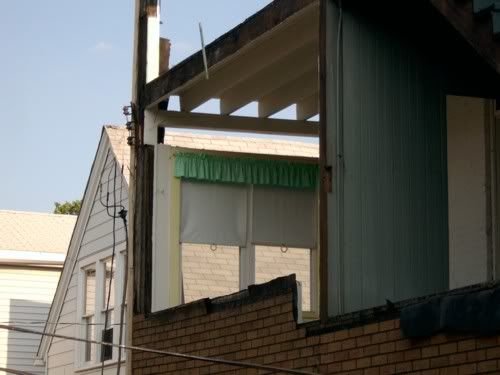
The demolition made a big mess. Debris fell in our back yard, and the fence caved in and blocked the sidewalk which leads to the entrance to our charming upstairs neighbor's place. They have stopped delivering her mail. Did I mention they don't have a permit? Trope has informed the Alderman's office.
Still, I hope they aren't stopped from finishing the project because the big hole is ghastly.

The Pit
I hated to see the old place go, it had class, and really nice woodwork. We walked around in there the week before it was demolished and took some nice little souvenirs – the little manual doorbells from the back stairwell, you spin the wind-up key and it makes a ring like an old telephone with a real bell – most of my readers may not even remember what that sounds like, although a coworker has a sample of one as a ring ton for his cell. I wish the place had been rehabbed or condo-ized rather than demolished, but I don’t know if we could start a family in so little space either. All this new construction is adding larger units to the city, which is good, but it’s doing so in such a way that makes it almost impossible for regular people to afford housing. Unfortunately, the kind of reform that would make a decent place to live in a decent neighborhood affordable for the rest of us will never be untertaken, because Americans count on rising home prices to finance their retirement. In other words, people who are already homeowners see rising property values as a good thing, and will fight any effort to drive prices down. So those of us who were born too late are S.O.L., I guess.
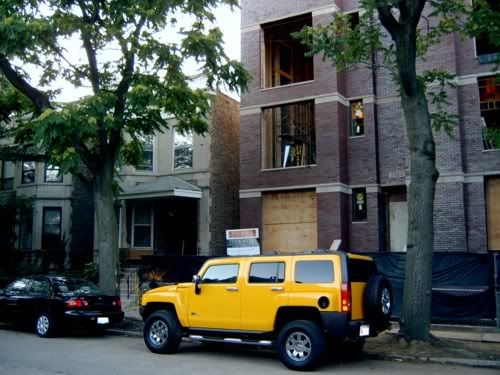
This picture says it all and doesn't need a caption. Yuck. This is what's happening to our neighborhood, which used to be cool.
Didn't mean to end on a grumpy note but I'm tired. Tomorrow there will be happy fun garden pictures, as well as some "what I did with my summer vacation" stuff.
Wednesday, August 03, 2005
you can't stop the signal
I'm not a big fan of the Wall Street Journal, especially it's editorial page, but I've been following the work of their man in Basra, Stephen Vincent, for several months. I found his perspective very informative, he seemed to be somewhat of a conservative who would like to be a war supporter, but also very honest in his depiction of what has been going on in Basra, supposedly a bright spot on the dreary Iraqi horizon. He was quite disturbed by what he saw and in the past couple months I've read some very intersting pieces by Vincent, which were trying to draw attention to what he was seeing there.
On Sunday, he had an Op-Ed piece in the New York Times depicting the overarching, repressive power wielded by Iranian-backed Shi'ite fundamentalist religious parties and militias in Basra. Yesterday, he was murdered. He was not a journalist caught in the crossfire of some clash between soldiers and insurgents, he was assassinated because of something he'd written. Since his recent work has focused on the penetration of the Basra police force, militiamen riding along with police and "disappearing" political opponents of the regime, it is likely that his murder was committed or ordered by Basra police.
The New York Times piece will go to archive in a few days, so I'm taking the unusual step of reprinting the whole damn thing here. He can't get royalties for it anyway, he's dead, and I figure if someone's going to kill him to shut him up, I want to make sure everyone hears him loud and clear. Also, here's a link to his blog, In The Red Zone. Check it out while it's still up.
Stephen Vincent was the 49th journalist to be killed in the Iraq conflict. He was murdered by police officers loyal to a fundamentalist religious regime installed in power by you government, a regime which intimidates, tortures and kills its political and religious opponents, a regime which your soldiers are being asked to risk their lives, every day, to protect. Hypocrisy is on the march!
. . . but the truth will out. Pass it on.
On Sunday, he had an Op-Ed piece in the New York Times depicting the overarching, repressive power wielded by Iranian-backed Shi'ite fundamentalist religious parties and militias in Basra. Yesterday, he was murdered. He was not a journalist caught in the crossfire of some clash between soldiers and insurgents, he was assassinated because of something he'd written. Since his recent work has focused on the penetration of the Basra police force, militiamen riding along with police and "disappearing" political opponents of the regime, it is likely that his murder was committed or ordered by Basra police.
The New York Times piece will go to archive in a few days, so I'm taking the unusual step of reprinting the whole damn thing here. He can't get royalties for it anyway, he's dead, and I figure if someone's going to kill him to shut him up, I want to make sure everyone hears him loud and clear. Also, here's a link to his blog, In The Red Zone. Check it out while it's still up.
Switched Off in Basra
By STEVEN VINCENT
Published: July 31, 2005
Basra, Iraq
THE British call it being "switched on" - a state of high morale and readiness, similar to what Americans think of as "gung ho" attitude. During the 10 days I recently spent embedded with the British-led multinational force in this southern Iraqi city, I met many switched-on soldiers involved in what the British call "security sector reform." An effort to maintain peace while training Iraqis to handle their own policing and security, security sector reform is fundamental to the British-American exit strategy. As one British officer put it, "The sooner the locals assume their own security, the sooner we go home."
From this perspective, the strategy appears successful. Particularly in terms of the city police officers, who are proving adept at the close-order drills, marksmanship and proper arrest techniques being drilled into them by their foreign instructors. In addition, police salaries are up, the officers have shiny new patrol cars, and many sport snazzy new uniforms. Better yet, many of these new Iraqi officers seem switched-on themselves. "We want to serve our country" is a repeated refrain.
From another view, however, security sector reform is failing the very people it is intended to serve: average Iraqis who simply want to go about their lives. As has been widely reported of late, Basran politics (and everyday life) is increasingly coming under the control of Shiite religious groups, from the relatively mainstream Supreme Council for the Islamic Revolution in Iraq to the bellicose followers of the rebel cleric Moktada al-Sadr. Recruited from the same population of undereducated, underemployed men who swell these organizations' ranks, many of Basra's rank-and-file police officers maintain dual loyalties to mosque and state.
In May, the city's police chief told a British newspaper that half of his 7,000-man force was affiliated with religious parties. This may have been an optimistic estimate: one young Iraqi officer told me that "75 percent of the policemen I know are with Moktada al-Sadr - he is a great man." And unfortunately, the British seem unable or unwilling to do anything about it.
The fact that the British are in effect strengthening the hand of Shiite organizations is not lost on Basra's residents.
"No one trusts the police," one Iraqi journalist told me. "If our new ayatollahs snap their fingers, thousands of police will jump." Mufeed al-Mushashaee, the leader of a liberal political organization called the Shabanea Rebellion, told me that he felt that "the entire force should be dissolved and replaced with people educated in human rights and democracy."
Unfortunately, this is precisely what the British aren't doing. Fearing to appear like colonial occupiers, they avoid any hint of ideological indoctrination: in my time with them, not once did I see an instructor explain such basics of democracy as the politically neutral role of the police in a civil society. Nor did I see anyone question the alarming number of religious posters on the walls of Basran police stations. When I asked British troops if the security sector reform strategy included measures to encourage cadets to identify with the national government rather than their neighborhood mosque, I received polite shrugs: not our job, mate.
The results are apparent. At the city's university, for example, self-appointed monitors patrol the campuses, ensuring that women's attire and makeup are properly Islamic. "I'd like to throw them off the grounds, but who will do it?" a university administrator asked me. "Most of our police belong to the same religious parties as the monitors."
Similarly, the director of Basra's maternity hospital, Mohammad Nasir, told me that he frequently catches staff members pilfering equipment to sell to private hospitals, but hesitates to call the police: "How do I know what religious party they are affiliated with, and what their political connection is to the thieves?"
It is particularly troubling that sectarian tensions are increasing in Basra, which has long been held up as the brightest spot of the liberated Iraq. "Are the police being used for political purposes?" asked Jamal Khazal Makki, the head of the Basra branch of the Sunni-dominated Islamic Party. "They arrest people and hold them in custody, even though the courts order them released. Meanwhile, the police rarely detain anyone who belongs to a Shiite religious party."
An Iraqi police lieutenant, who for obvious reasons asked to remain anonymous, confirmed to me the widespread rumors that a few police officers are perpetrating many of the hundreds of assassinations - mostly of former Baath Party members - that take place in Basra each month. He told me that there is even a sort of "death car": a white Toyota Mark II that glides through the city streets, carrying off-duty police officers in the pay of extremist religious groups to their next assignment.
Meanwhile, the British stand above the growing turmoil, refusing to challenge the Islamists' claim on the hearts and minds of police officers. This detachment angers many Basrans. "The British know what's happening but they are asleep, pretending they can simply establish security and leave behind democracy," said the police lieutenant who had told me of the assassinations. "Before such a government takes root here, we must experience a transformation of our minds."
In other words, real security reform requires psychological as well as physical training. Unless the British include in their security sector reform strategy some basic lessons in democratic principles, Basra risks falling further under the sway of Islamic extremists and their Western-trained police enforcers.
Steven Vincent, the author of "In the Red Zone: A Journey Into the Soul of Iraq," is writing a book about Basra.
Stephen Vincent was the 49th journalist to be killed in the Iraq conflict. He was murdered by police officers loyal to a fundamentalist religious regime installed in power by you government, a regime which intimidates, tortures and kills its political and religious opponents, a regime which your soldiers are being asked to risk their lives, every day, to protect. Hypocrisy is on the march!
. . . but the truth will out. Pass it on.
Subscribe to:
Posts (Atom)