My irregular musings on city life, politics, baseball, roller derby, and whatever happens to be getting my goat today.

Tuesday, August 23, 2005

Rumors of my death have been greatly exaggerated

Image hosted by Photobucket.com

Air show this weekend. We didn’t go this year (not in the mood for militarism) but you could hear the blasting jet engines all over time. The sound reminds me of the days after 9/11 when all civilian flights were grounded and NATO fighters were patrolling the skies over Chicago.

We watched the disaster unfold on television in a friend’s seventh floor apartment in Hyde Park. When the first fighter planes cruised overhead, she yelled OH MY GOD THEY”RE COMING!!! And hit the floor. No, it wasn’t funny later, it was funny right the fuck then, you could feel the tension breaking like ice snapping in a glass of gin.

Anyway, I haven’t been writing lately. For one thing, much of the interesting stuff that’s gone on in the last couple weeks has been at work, and I just won’t blog about that. It would be damned unprofessional. But it leaves me drained, and it’s hard to find the energy to talk about other things.

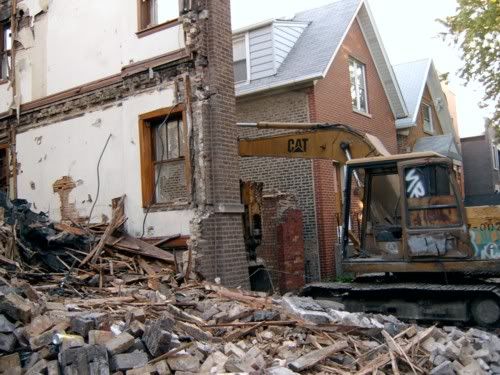
Big things are up in the neighborhood. Developers’ minions have torn down the apartment building next door and are pouring the foundation for a new one, all without the benefit of a valid city permit!

Image hosted by Photobucket.com
The street that was . . .

Image hosted by Photobucket.com

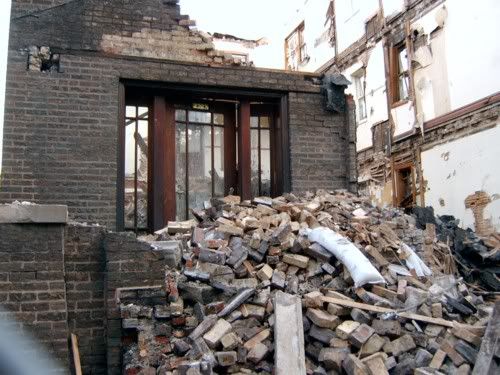
The demolition made a big mess. Debris fell in our back yard, and the fence caved in and blocked the sidewalk which leads to the entrance to our charming upstairs neighbor's place. They have stopped delivering her mail. Did I mention they don't have a permit? Trope has informed the Alderman's office.

Still, I hope they aren't stopped from finishing the project because the big hole is ghastly.
Image hosted by Photobucket.com
The Pit

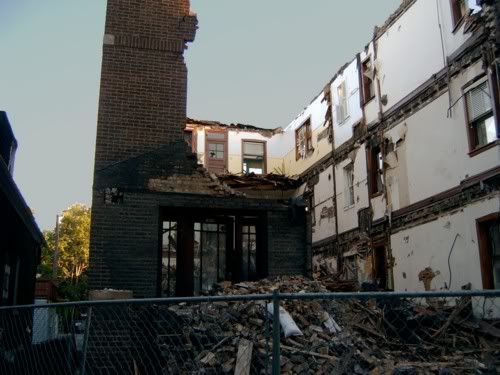
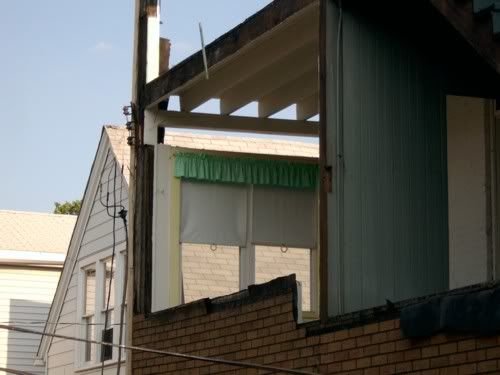
I hated to see the old place go, it had class, and really nice woodwork. We walked around in there the week before it was demolished and took some nice little souvenirs – the little manual doorbells from the back stairwell, you spin the wind-up key and it makes a ring like an old telephone with a real bell – most of my readers may not even remember what that sounds like, although a coworker has a sample of one as a ring ton for his cell. I wish the place had been rehabbed or condo-ized rather than demolished, but I don’t know if we could start a family in so little space either. All this new construction is adding larger units to the city, which is good, but it’s doing so in such a way that makes it almost impossible for regular people to afford housing. Unfortunately, the kind of reform that would make a decent place to live in a decent neighborhood affordable for the rest of us will never be untertaken, because Americans count on rising home prices to finance their retirement. In other words, people who are already homeowners see rising property values as a good thing, and will fight any effort to drive prices down. So those of us who were born too late are S.O.L., I guess.
Image hosted by Photobucket.com
This picture says it all and doesn't need a caption. Yuck. This is what's happening to our neighborhood, which used to be cool.

Didn't mean to end on a grumpy note but I'm tired. Tomorrow there will be happy fun garden pictures, as well as some "what I did with my summer vacation" stuff.

Wednesday, August 03, 2005

you can't stop the signal

I'm not a big fan of the Wall Street Journal, especially it's editorial page, but I've been following the work of their man in Basra, Stephen Vincent, for several months. I found his perspective very informative, he seemed to be somewhat of a conservative who would like to be a war supporter, but also very honest in his depiction of what has been going on in Basra, supposedly a bright spot on the dreary Iraqi horizon. He was quite disturbed by what he saw and in the past couple months I've read some very intersting pieces by Vincent, which were trying to draw attention to what he was seeing there.

On Sunday, he had an Op-Ed piece in the New York Times depicting the overarching, repressive power wielded by Iranian-backed Shi'ite fundamentalist religious parties and militias in Basra. Yesterday, he was murdered. He was not a journalist caught in the crossfire of some clash between soldiers and insurgents, he was assassinated because of something he'd written. Since his recent work has focused on the penetration of the Basra police force, militiamen riding along with police and "disappearing" political opponents of the regime, it is likely that his murder was committed or ordered by Basra police.

The New York Times piece will go to archive in a few days, so I'm taking the unusual step of reprinting the whole damn thing here. He can't get royalties for it anyway, he's dead, and I figure if someone's going to kill him to shut him up, I want to make sure everyone hears him loud and clear. Also, here's a link to his blog, In The Red Zone. Check it out while it's still up.
Switched Off in Basra

By STEVEN VINCENT

Published: July 31, 2005

Basra, Iraq

THE British call it being "switched on" - a state of high morale and readiness, similar to what Americans think of as "gung ho" attitude. During the 10 days I recently spent embedded with the British-led multinational force in this southern Iraqi city, I met many switched-on soldiers involved in what the British call "security sector reform." An effort to maintain peace while training Iraqis to handle their own policing and security, security sector reform is fundamental to the British-American exit strategy. As one British officer put it, "The sooner the locals assume their own security, the sooner we go home."

From this perspective, the strategy appears successful. Particularly in terms of the city police officers, who are proving adept at the close-order drills, marksmanship and proper arrest techniques being drilled into them by their foreign instructors. In addition, police salaries are up, the officers have shiny new patrol cars, and many sport snazzy new uniforms. Better yet, many of these new Iraqi officers seem switched-on themselves. "We want to serve our country" is a repeated refrain.

From another view, however, security sector reform is failing the very people it is intended to serve: average Iraqis who simply want to go about their lives. As has been widely reported of late, Basran politics (and everyday life) is increasingly coming under the control of Shiite religious groups, from the relatively mainstream Supreme Council for the Islamic Revolution in Iraq to the bellicose followers of the rebel cleric Moktada al-Sadr. Recruited from the same population of undereducated, underemployed men who swell these organizations' ranks, many of Basra's rank-and-file police officers maintain dual loyalties to mosque and state.

In May, the city's police chief told a British newspaper that half of his 7,000-man force was affiliated with religious parties. This may have been an optimistic estimate: one young Iraqi officer told me that "75 percent of the policemen I know are with Moktada al-Sadr - he is a great man." And unfortunately, the British seem unable or unwilling to do anything about it.

The fact that the British are in effect strengthening the hand of Shiite organizations is not lost on Basra's residents.

"No one trusts the police," one Iraqi journalist told me. "If our new ayatollahs snap their fingers, thousands of police will jump." Mufeed al-Mushashaee, the leader of a liberal political organization called the Shabanea Rebellion, told me that he felt that "the entire force should be dissolved and replaced with people educated in human rights and democracy."

Unfortunately, this is precisely what the British aren't doing. Fearing to appear like colonial occupiers, they avoid any hint of ideological indoctrination: in my time with them, not once did I see an instructor explain such basics of democracy as the politically neutral role of the police in a civil society. Nor did I see anyone question the alarming number of religious posters on the walls of Basran police stations. When I asked British troops if the security sector reform strategy included measures to encourage cadets to identify with the national government rather than their neighborhood mosque, I received polite shrugs: not our job, mate.

The results are apparent. At the city's university, for example, self-appointed monitors patrol the campuses, ensuring that women's attire and makeup are properly Islamic. "I'd like to throw them off the grounds, but who will do it?" a university administrator asked me. "Most of our police belong to the same religious parties as the monitors."

Similarly, the director of Basra's maternity hospital, Mohammad Nasir, told me that he frequently catches staff members pilfering equipment to sell to private hospitals, but hesitates to call the police: "How do I know what religious party they are affiliated with, and what their political connection is to the thieves?"

It is particularly troubling that sectarian tensions are increasing in Basra, which has long been held up as the brightest spot of the liberated Iraq. "Are the police being used for political purposes?" asked Jamal Khazal Makki, the head of the Basra branch of the Sunni-dominated Islamic Party. "They arrest people and hold them in custody, even though the courts order them released. Meanwhile, the police rarely detain anyone who belongs to a Shiite religious party."

An Iraqi police lieutenant, who for obvious reasons asked to remain anonymous, confirmed to me the widespread rumors that a few police officers are perpetrating many of the hundreds of assassinations - mostly of former Baath Party members - that take place in Basra each month. He told me that there is even a sort of "death car": a white Toyota Mark II that glides through the city streets, carrying off-duty police officers in the pay of extremist religious groups to their next assignment.

Meanwhile, the British stand above the growing turmoil, refusing to challenge the Islamists' claim on the hearts and minds of police officers. This detachment angers many Basrans. "The British know what's happening but they are asleep, pretending they can simply establish security and leave behind democracy," said the police lieutenant who had told me of the assassinations. "Before such a government takes root here, we must experience a transformation of our minds."

In other words, real security reform requires psychological as well as physical training. Unless the British include in their security sector reform strategy some basic lessons in democratic principles, Basra risks falling further under the sway of Islamic extremists and their Western-trained police enforcers.

Steven Vincent, the author of "In the Red Zone: A Journey Into the Soul of Iraq," is writing a book about Basra.

Stephen Vincent was the 49th journalist to be killed in the Iraq conflict. He was murdered by police officers loyal to a fundamentalist religious regime installed in power by you government, a regime which intimidates, tortures and kills its political and religious opponents, a regime which your soldiers are being asked to risk their lives, every day, to protect. Hypocrisy is on the march!

. . . but the truth will out. Pass it on.

Sunday, July 17, 2005

Hiatus

Windy City Blues will be off line for the next ten days or so, since I'll be out of town and away from my computer. The next few days I'll be unreachable by e-mail or cell phone, as I'm leaving the civilized world behind to go fishing. After that I'm going to the beach. I've obviously been very cranky lately and a little time without thinking about anything should do me good. I'll start posting again by the beginning of August.

Friday, July 15, 2005

The Good Guys?

So I'm a science fiction fan. I don't go to conventions dressed up like Greedo or anything, but if a movie comes out involving invading aliens, time travel, zombies, robots, or spaceships blowing up you'll often find me there. Mostly this has been a bit of healthy escapism from a stressful life that has me guzzling antacid and watching my blood pressure at the age of 33.

But recently, I'm finding that the genre has been a rare sanctuary for moral ambiguity in absolutist times. You may have heard that the final Star Wars movie came out a couple months back. I know the last few haven't been that great, but the orignial movie came out when I was five and I sort of imprinted to it like a puppy to its new owner. Since that tender age, I had always wondered about the big guy in black, why he would have betrayed his old friends and been so mean to everyone. The new flick was supposed to finally give an answer to my questions.

Well, it turns out that once I knew his reasons, I felt like I would have done the same thing. Switch to the dark side in order to gain the power to stop my loved ones from dying and hold on to what I have and fear to lose? It sounds like a fair deal to me. Not the "right" thing necessarily, but understandable. It turns out Darth Vader was not a madman seeking to stamp out all that is good and right in the world, but a guy who did what he thought he had to do and got taken.

I'm not gonna tell you it's the greatest movie ever - some of the line deliveries are like high school students doing Shakespeare - but it made me think about matters of ultimate concern. And that's a lot more than you can say for most things these days.

Which brings me to what is absolutely, undisputably the best TV show out there. A show that you should really watch, and that means something coming from me because usually I'm gonna tell you that TV is a waste of valuable time where you could be doing something with your life. I hear that Americans on average watch five or six hours of TV a day and I can't understand how it's possible, although I guess it explains a lot. Ordinarily, almost anything is better than TV. TV makes you fat and stupid. Boxing is better for you than TV. Shoplifting, polka, even just sitting alone in the dark and drinking heavily is better than TV. Hell, even golf, if it's a nice enough day.
But you should probably watch this. No, it's not the freakin' West Wing. Nothing annoys me more than people who know more about what Josiah Bartlett is doing than what George Bush is doing. Such people deserve to be oppressed. No, I'm talking about the remake of Battlestar Galactica. Yes, like that cheesy show from the 70s with the hair and the King Tut helmets and the robot dog who was played by a monkey.

Go ahead, laugh. But it's still the best show on television. Not because it portrays deep and conflicted characters and relationships in the manner of the Supranos or Six Feet Under, although it does. Not because it's groundbreaking in the way it combines documentary-style cinematography with CGI to create a gritty, recognizable world, although it is.

Image hosted by Photobucket.com
The new model killer robots are way cooler.

It's the best thing out there because it takes our times seriously. In the aftermath of the September 11 attacks we were all going to emerge from our soulless bimbo consumer culture and be a serious nation again. Remember that? It lasted about three weeks. Then we all decided to turn the videos back on, block out the world with iPod ear buds, stick a yellow ribbon magnet on our cars and stick our heads back in the sand. How noble.

In mainstream culture, the only impact the Age of Terror has had is to produce some TV dreck about heroic CIA agents and how they put their lives on the line to protect us even though sometimes they have to break the rules and go kick some ass to do it. Ah, fascist propaganda is so comforting!

And then there's Battlestar Galactica, with its religious fanatic suicide bombers, its senseless attack on the civilian population, it's wall of "Have You Seen Me?" pictures of the missing and presumed dead, its political prisoners dressed in orange and living in cages, its protagonists torturing and killing detainees, its paranoid understanding that the terrorists could be anyone in the room. On the one side, monotheistic fanatics who claim to know the will of God and are willing to sacrifice themselves to enforce it. On the other side, a faith-based administration led by a born-again President convinced that she's the one doing God's will. Yet both the Quaeda figures and the Bush administration stand-ins evoke a certain sympathy in me, which is quite an accomplishment since I'm not inclined to cut either party any slack here in the real world. When you find yourself watching an attempted coup and you don't know who to pull for, that's an accomplishment, too.

I'm not eggagerating when I say this is a space opera that can expand your moral imagination. When you know one of the characters is an enemy sabateur and you fear for her safety anyway, when you sympathize with traitors and warmongers and terrorists all, you know you're seeing a new classic being born. The key to its success is nothing more complicated than staying true to its premise. After genocide, innocence is lost.

In this country, our instinct has been to close our eyes to protect our innocence. To hide behind faith or ideology or outrage, but to look around, always, for the good guys crusadig to push back the forces of evil.

But there are not good guys in this life. Just people struggling to survive, and to get what they want. And the show is like that. It's not that they are dark anti-hero types. They're actually charming, funny, compassionate, lusty, normal people. But they're not embodying some ideal we should try to emulate. Mostly they're trying not to die, in trying times strikingly similar to our own.

If you think I'm reading too much into a TV show with spaceships, here's Mary McDonnell, who plays the embattled President Roslin on the show:
The thing I love most about "Battlestar" is the question it's raising – and this season, the question is more prominent – of how do we perceive ourselves in relation to 'the other'? That is the essential question to me of our planet. Until we understand that the other is us, we are going to be continually in these wars and do things that create divisiveness.

A lot of what I see in the world is us and them, the good guy and the bad guy. To begin to understand that there's a bit of projecting on the bad guy and that he's a part of us … That's kind of why this show is so compelling. Even when people don't quite get it, there is something in here that we need to evolved toward.

"Battlestar" airs at 9pm central time on Fridays on the Sci Fi Channel. The show's second season begins tonight, and you should watch it. And then turn off the damn tube before you get to the show with the dredlocked, life-sucking tick people. Boy is that not good.

Speaking of modern-day fears, coming back from a play last night I grew suspicious of a guy on the subway looking nervous and clutching a backpack. I told Trope about this and we got off the train and waited for another one. I know it's paranoid. If I really thought he had a bomb, shouldn't I have punched him in the face and grabbed the bag or something? But that would be rude and illegal, so I just got off and left the rest of the passengers to their non-fate. I know that's not the best or sanest way to deal with the situation we find ourselves in, but it made sense at the time. This is a truth about me, I plan on living through this whether the rest of y'all do or not.
Thursday, July 14, 2005

Why I am not a libertarian part 762

Horrible news coming out of Kenya today, which I'm sure no one around here is paying attention to because no one seems to care much about Africa.
Thousands of villagers in northern Kenya fled their homes in fear as new
inter-clan violence wracked parts of the remote region after at least 77 people
were killed in a brutal massacre and reprisal attacks this week, officials and
residents of the area said. . .

members of the rival Borana and Gabra clans, which have long-running
disputes over water and pasture, continued to clash two days after the attack on
Turbi which has been blamed on the Borana. . .

The death toll from three days of clashes had stood at 76 earlier Thursday
but after one of 10 Boranas reported killed on Wednesday was found alive but
critically injured, the two new confirmed deaths brought the total to 77 dead,
officials said.

The flight of the villagers and new killings came 48 hours after 300 to
500 heavily armed Borana raiders slaughtered 56 Gabra villagers, including 22
children, in Turbi on Tuesday.

At least 10 of the attackers were killed during and after the raid that
was followed by a revenge attack in which nine Boranas, including four children,
after Garbas pulled them from a car driven by a priest near Sololo.

I hear lots of people complain about government and blithely claim that people would be better off if they were allowed to fend for themselves or form noncoercive, cooperative communities in freedom. Unfortunately, that's just not what people are like. Whenever state authority is withdrawn, people quickly resort to violence to obtain the resources and power they think they need to survive.

In an organized state, disputes over water and land are resolved by laws and court systems, which provide a system for making these decisions which may not be perfect or fair, but at least doesn't involve machetes.

In other words, a core function of government is to play Solomon and hack the baby in half, so you don't go kill 4 of them.

You believe you would be different in a lawless world. You look in the mirror and all you see is the makeup, or the cool shirt, or the hair. You don't see the monster that lurks beneath the skin. That frightens me. Because I know it's in there.

One of the first steps in learning to live as a decent adult person is admitting to yourself that you just don't deserve to get everything you want by any means necessary. You're not that special. You are not a beautiful and unique snowflake.

Libertarians in essence believe that if everybody goes out and just selfishly tries to get whatever they want and works for their own happiness, that the result will be the greatest good for the greatest number. This is fatuous and false. In reality under such a system, the strong will take what they want from the weak. The greatest good for the greatest number is accomplished when the biggest dog on the block is not a wealthy individual or corporation but a government, which takes power from the strong and gives it to the weak to level the playing field. The problem with governments in practice is that they become corrupted by the wealthy and powerful, not that the trample the alleged rights of property.

Just because I make common cause with them when I feel our government is overstepping its constitutional bounds doesn't make me one of them. I'm not sure what you'd call me, but I'm closer to the New Deal than the Cato Institute.

Big Government now, Big Government forever.

Friday, July 08, 2005

There are no children here

Before the O'Connor resignation and the return of al Quaeda, the big news around here was that the Census Bureau's guess is that Chicago's population is shrinking again. After growing by about 4% in the 1990s, the Bureau estimates that the city has lost about 2% of its population since 2000. In fact, almost all of the older big cities have begun to lose population again. Does this mean that the apparent resurgence of big American cities in the 1990s was an illusion?

We could be getting a bit carried away here. After all, proportionally speaking the declines are very small. Fourteen thousand people are a drop in the bucket in Chicago. And anyway, the Census Bureau went right on predicting declines throughout the 1990s until the actual head count proved them wrong - and the process still undercounted big city residents by quite a bit, since the insistence by Congress that the Bureau not use sampling meant that many immigrants and other marginalized populations were missed.

So the Bureau may or may not be correct that the city is shrinking in absolute terms. But they are basing their projections on pretty valid stuff. They have correctly identified the two big demographic trends which are pulling the population in two directions: an increase in the number of housing units, and the decrease in average family size.

In plain English, most people who live here have been under the impression that the city was growing, due to the ubiquitious construction of new housing, which has spread to neighborhoods like Garfield Park and Englewood, previously left for dead since the days of redlining. But while it's true that the number of households has been slowly expanding, it's also true that the average family size has been falling, which may be driving the population down.

It works like this. Ten years ago, that old two-flat on your street was home to a family of four and a family of three. It was torn down to build three modern condos, which now house two yuppies each. The number of units has increased from two to three, but the number of residents on the lot has fallen from seven to six. Something very similar has happened to the city as a whole. The result is a net outmigration from the city - the families who are leaving are larger than those moving in. This was true even during the population growth of the 1990s, when more people moved out than in, but the population grew anyway because there were more births than deaths. But those gains may be short lived, since families with children are the group most likely to move out.

Let's look at the city which has lost the most population since 2000. San Francisco already has the smallest proportion of children of any city in the United States. Just 14.5 percent of the city's population is 18 and under. And a recent survey shows 40 percent of the city's remaining parents are considering moving out in the next year. What's going on?

The AP story (I just linked to it, ya bums!) indicates that the obvious first guess is off base - while the city's large gay population may have some role in it's relative childlessness, gay and lesbian San Franciscans are in fact increasingly raising children. The problem seems to be in the real estate "market."*
Another reason San Francisco’s children are disappearing: Family housing in the city is especially scarce and expensive. A two-bedroom, 1,000-square-foot starter home is considered a bargain at $760,000.

Things are not quite so bad here in Chicago, but we still have a situation in which every bedroom in a home, whether rented or owned, requires a full-time job to pay for it. So a two bedroom needs two employed people,etc. One reason it's difficult to raise children here is that there's simply nowhere to put them. And while older houses like mine once routinely housed large families, by middle class American standards there's just not enough room here for little ones.

This in part has spurred the increased construction of larger homes and condos in the city, especially close to amenities like parks and Lake Michigan. But the expense of these places, plus the perception that schools are unsafe and terrible, and the widespread fear of black people that places many affordable neighborhoods on an unofficial no go list for white, asian and latino families, have all led young families to leave the city in droves as their children reach school age.

So while Chicago is clearly not going the way of Detroit, it is failing to thrive. And a childless city and segration of the population by age and stage of life may have political and cultural consequences worth contemplating.

For one thing, families get to vote their children in Congress. Because congressional districts are drawn up according to the number of residents, not adults or citizens or voters. So if you're in a child-dense area, your vote counts more because there are fewer voters per Representative. This leads to a pattern of urban areas helping to elect statewide officeholders, but only getting a minority of their state's congressional seats. But that's a policy wonkish complaint. A bigger problem is that by segregating communities by lifestyle, we lose interest in the needs of other people, be they minorities or parents or the elderly, and we lose the sense of identity and continuity that comes from a multigenerational community.

Also, having grown up in the burbs I can tell you firsthand what a bad idea it is. For some reason there are many people who think they know so much about how the world should be that the deserve the power to control what their children see and hear and learn about the world in order to keep them safe and teach them values. The result has been to convince their offspring in the existence of a smiling, happy, traditional America that never really existed outside of Norman Rockwell paintings. Traditional America was racist, oppressive, violent, and for most Americans, desperately poor and a struggle for survival. To say "except for the bigotry, violence, poverty and oppression it was a pretty good society" is like saying "except for the Hundred Years War it was a pretty good century."**

On a happy note, I write this after hearing the news that there are at least two new babies in this city over the last few days. Congratulations to Thistles and Winnemac, and to Dayna!

*Yeah, I hate ironic quotes too, but I can't bear to discuss real estate without pointing out somehow the huge role that government policies have had in shaping the market. If you believe that the patterns of construction we have built up in this country are the result of consumer tastes and supply and demand, you're out of your mind.

**Apologies to Molly Ivins.

Thursday, July 07, 2005

the dead

So I woke up this morning haunted by images of dismembered corpses. At first I thought I'd been dreaming about zombie movies again, but it was just more terrorists. This has been happening daily in Iraq for months, but somehow we're shocked that it's spread to London. What's really surprising to me is that it took so long. It's not like a commuter train, or a highway (imagine a couple Oklahoma City style truck bombs going off in a rush hour traffic jam) or any other public parade of people can really be safe.

But as part of the global city here, I'm starting to feel a little bit picked on here. It's becoming apparent to me that we all have a lot in common, as compared to, well, those other people. I mean, we're cosmopolitan, tolerant of human differences, less religiously observant, more mobile and worldly, less likely to support war and cultural conservatism. Urban Americans didn't back George Bush's war in Iraq. Londoners similarly opposed British participation in that effort. The people of Kabul opposed the Taliban and don't like Osama bin Laden much at all. Baghdadis didn't support Saddam Hussein and mostly don't back the religious extremists in power now either. So who's responsible for all this murder and mayhem? Who backs either imperialism or terrorist extremists, depending on what country they come from? Rural, backward, xenophobic, religious fundamentalist rubes. People who don't know anything beyond their own little village way of life and think everyone else should be just like them or else they're wrong and bad. Hicks. Sad little people who want to be respected like their ideas and values are just as good as anybody else's even though "values" are mostly hate and fear because they don't know anything about anyone else.

Part of me knows this is offensive but I just don't care anymore, I'm just angry. I don't ask that you be just like me or share my values, I just want you to go away and leave me alone. You do your thing, I do mine, but I just don't want to hear about it. I don't want to be saved. I just don't care. I've got nothing personal against religious people, some of them are my friends and family, but I'm not going to adopt your beliefs no matter what you say, and blowing people up isn't going to change my mind or intimidate me, it's just going to make me think less of you and your so called values. What kind of God would rejoice at the bombing of a bus, or an abortion clinic, or an insurgent-occupied city? If the rubes of the world want to kill each other to show how tough they are and how big their God is, there's nothing I can do about it at this point. But leave my people out of it.

Enough anger for one day. Here are some pictures of our garden to chill out to.

Image hosted by Photobucket.com
Here's the mysterious Trope and some purple pansies.

Image hosted by Photobucket.com
Okay, so they're not all the same breed of Vinca. But I think they're cool looking.

Image hosted by Photobucket.com
I put this border in myself the day the pope died. Check out the flourishing herbs. The basil is especially impressive and makes a good pasta bake.

Image hosted by Photobucket.com
This was cool. I planted an onion that sprouted on the shelf. It grew into a really interesting plant. These guys used to grow wild before there was a city here. Chicago means roughly "place of the wild onion."

Image hosted by Photobucket.com
The jungle corner under the garage stairs. Notice the hydrangia on the left, it was bedraggled when I bought it, a post-Easter bargain, but I liked the color. It's going to bloom again soon.

Image hosted by Photobucket.com
This spiny desert thingy grew back from seed - we had this type of plant in this pot last year, and a new one appeared with very little help from us.

Image hosted by Photobucket.com
The same thing happened with these snapdragons, of which this is not a good picture. We were about to plant something else in this pot when we saw the sprouts. Isn't nature cool?

Image hosted by Photobucket.com
These guys appeared out of a crack in the cement, just under where the snapdragon pot spent most of last summer on the porch. Apparently Chicago is a good climate to grow snapdragons from seed.

Unfortunately, I don't have a picture of the monster rhubarb bush right now, so you'll just have to take my word for it that it's mighty impressive. We also have some mint, which we use for mojitos.

There I feel calmer. Don't you? Sorry I offended you dangerous delusion that you speak for an all-powerful, infallable God (the two would be mutually exclusive, to my way of seeing things). So please, put the bombs down.