Nosebleed seats with a great skyline view?
check.
Sausage?
check.
Grilled onions?
check.
Old Style?
check.
Rain Slicker?
check.
Souvenir with corporate logo attached?
check. (pink Cubs hats for the ladies).
Loud, happy crowd undimmed by the raid delay?
check.
Underperfoming starting pitcher?
check.
Humiliating loss to a subpar opponent?
check.
It must be Wrigley Field. The 9-0 loss makes the boys 25-2 over 2 days! Vs the Brewers!
But did I mention the cool pink hats? Trope should be able to pick off the MasterCard logo in a couple of days.
Sunday, April 30, 2006


Tuesday, April 25, 2006
Jane Jacobs 1916-2006

I hate to see a name I recognized accompanied by dates for the first time, the closed parentheses of a life. It means somebody important is gone, and if you wanted to ask them something, it's too late now. Jane Jacobs has been a huge, if indirect, influence on my life for several years. While I'll come right out and confess that I've never read "The Death and Life of Great American Cities," her articulation of what went wrong with urban America at midcentury and how to fix it has trickled down to influence where and how I live, what I do with my life, and what kind of country I want to live in, and it's sad to hear she's gone. Ironically, I heard about her death, and heard an interview with her discussing a successful attempt to organize her Toronto neighborhood to stop the demolition of historic housing, as I was taking a spin throught the neighorhood trying to capture yet another demolition on film:
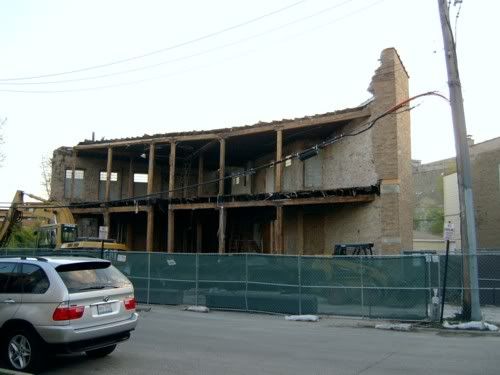
Jacobs is dear to my heart not so much because she wrote about cities, but because she was so often successful in opposing misguided "urban renewal" and preserving what is essential about neighborhood life. Once she even stopped Robert Moses from building an expressway through lower Manhattan! Imagine if that monster had been built, it would have destroyed Downtown more thoroughly than Osama could ever dream of.
Jacobs wrote a lot of stuff you should read, but I'll sum up:
* Density is good, it leads to diverse, interesting places to live.
* A crowded street is safer than an empty one.
* Small businesses give life and charater to a neighborhood
* The car is not necessarily an improvement over walking and public transportation.
Basic stuff, but it certainly was news to the modernist misplanners of midcentury.
I miss her already.
Skyway
So I make one stupid Barbie joke and look what happens. They're selling naming rights to the Skyway! Since all the employers down that way have pretty much disappeared, I wonder who's left to sponsor an elevated expressway and exactly what they'd hope to gain from putting their name on a place where people sit trapped and frustrated in traffic for hours each week. Apple? I can see the iPod Skyway working out I guesss. A cell phone company? Been there, done that with US Cellular Field. Maybe the Dan Ryan, which goes right by the ballpark, but not the Skyway. Plus, using a cell phone while driving is illegal in Chicago. Unless you have a headset! That's it, the Bluetooth Skyway!
Alas, it will probably just be Hummer.
Alas, it will probably just be Hummer.
Saturday, April 22, 2006
Stop Breaking Down
So I'm driving in Chicago's Wild West Side, Hank williams on the radio hits me like morphine but without the horrible buzzing head rush. Ahead an 18 story crane tears at concrete, I watch the projects coming down. Hank's so lonesome he could cry. You think he's out of place? You don't think this is the desert? This is the Pueblo ruins, crumbling husks of buildings and the footprints of buildings, where you can retrace the steps of vanished people on the ghosts of streets. The lines and borderes once reinforced by social convention fall back into the natural world, just shapes now, not borders at all. You can walk any which way, stand in the street, jump the curb, meander among the rubble in the blinding sun. I drie maybe half a mile along Adams before I realize it's supposed to be one way - the other way.
There is nobody else driving here.
I do find a little knot of trucks sitting haphazardly in the middle of the road. A van. A red pickup with guys sitting in the back drinking beer. They are watching the monolith fall. A crane and a little work crew are battering the half-demolished concrete mountain again and again. They were here yesterday too - the crews and the crowd both. They don't seem to be making much progress.
You'd never know you were in America's third largest city. This is a wasteland - a ruin. People are surprised to learn that the population density of Chicago is actually less than that of Los Angeles - LA is more suburban-looking, but doesn't contain the vast stretches of postindustrial emptiness and ruin. The first time, they tore this neighborhood down to build the monoliths, to cantain the black population and prevent its westward spread. It didn't work. The white population fled beyond the city to points west - and middle class blacks followed. After the riots of 1968, the population plummeted as everyone who could leave trickled out. House after house was demolished, whole blocks gone or with a few buildings left, standing irregularly, little clumps huddling against the cold and emptiness, separated by stretches of weeds and crumbling asphalt. Trees have grown up where homes once stood.
Beyond the crumbling projects, I can see new luxury condos going up. It seems pretty naive - the condos are buing build at city density, but ther eare so few of them, new clumps on the new prarie. If they put housing up on all these abandoned blocks, who will live there? The Census Bureau believes the city population is falling again. There are no grocery stores here, no bars, nothing but churches, liquor stores, beauty salons. The locationis great, we're right on the highway, close to the Loop, close to the Green Line. But nobody wants these neighbors.
Part of me thinks nothing could bring middle class whites to the West Side in large numbers (short of full scale ethnic cleansing). The reality is, they flee further and further from anyone unlike themselves. The reality is, the city has lost a quarter of its population since 1950. At this point, the entire Chicago region is losing population to outmigration.
What was once the nation's liveliest metropolis has been slowly transforming itslef to one type of wasteland or another. Postindustrial sludge. Sprawling subdivided suburbia. Ghost town neighborhoods of the South and West sides. The rubble where the projects once stood.
Somewhere in Tim Samuelson and Camilo Jose Vergara's Unexpected Chicagoland is the line:
True, she's coming back. She's out of the ICU and eating solid food. But half of Chicago is still Detroit. In fact most of our major cities are dying slowly, neglected - New Orleans was being destroyed day be day long before the hurricane hit . . .
Anyway, I took pictures.
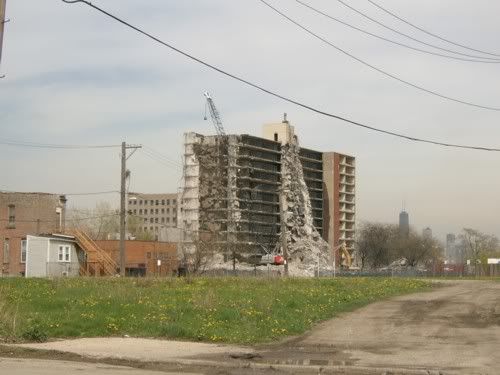
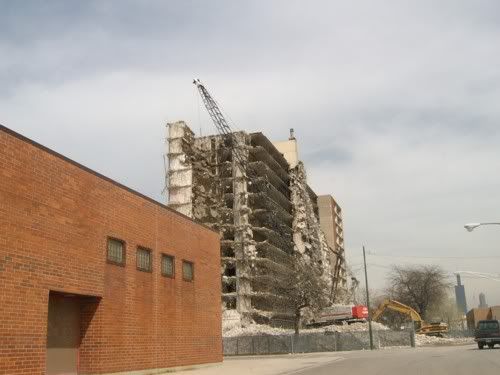
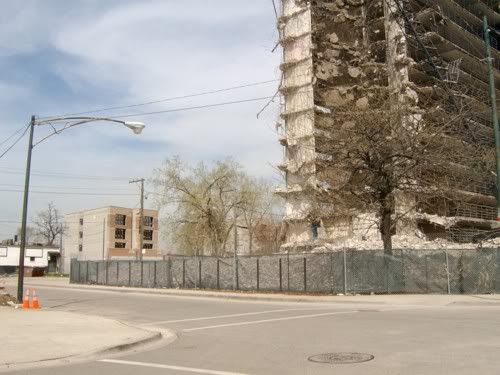
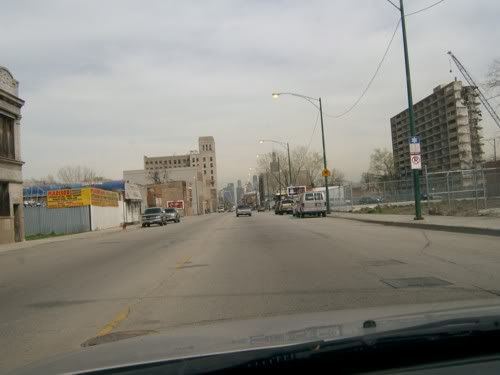
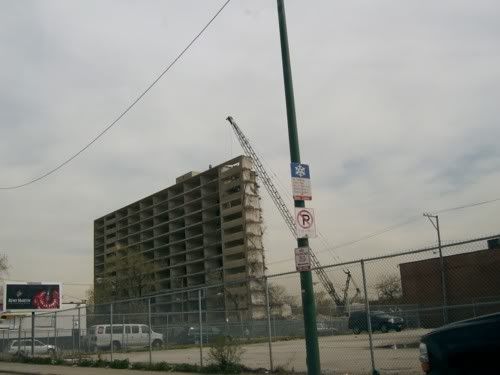

There is nobody else driving here.
I do find a little knot of trucks sitting haphazardly in the middle of the road. A van. A red pickup with guys sitting in the back drinking beer. They are watching the monolith fall. A crane and a little work crew are battering the half-demolished concrete mountain again and again. They were here yesterday too - the crews and the crowd both. They don't seem to be making much progress.
You'd never know you were in America's third largest city. This is a wasteland - a ruin. People are surprised to learn that the population density of Chicago is actually less than that of Los Angeles - LA is more suburban-looking, but doesn't contain the vast stretches of postindustrial emptiness and ruin. The first time, they tore this neighborhood down to build the monoliths, to cantain the black population and prevent its westward spread. It didn't work. The white population fled beyond the city to points west - and middle class blacks followed. After the riots of 1968, the population plummeted as everyone who could leave trickled out. House after house was demolished, whole blocks gone or with a few buildings left, standing irregularly, little clumps huddling against the cold and emptiness, separated by stretches of weeds and crumbling asphalt. Trees have grown up where homes once stood.
Beyond the crumbling projects, I can see new luxury condos going up. It seems pretty naive - the condos are buing build at city density, but ther eare so few of them, new clumps on the new prarie. If they put housing up on all these abandoned blocks, who will live there? The Census Bureau believes the city population is falling again. There are no grocery stores here, no bars, nothing but churches, liquor stores, beauty salons. The locationis great, we're right on the highway, close to the Loop, close to the Green Line. But nobody wants these neighbors.
Part of me thinks nothing could bring middle class whites to the West Side in large numbers (short of full scale ethnic cleansing). The reality is, they flee further and further from anyone unlike themselves. The reality is, the city has lost a quarter of its population since 1950. At this point, the entire Chicago region is losing population to outmigration.
What was once the nation's liveliest metropolis has been slowly transforming itslef to one type of wasteland or another. Postindustrial sludge. Sprawling subdivided suburbia. Ghost town neighborhoods of the South and West sides. The rubble where the projects once stood.
Somewhere in Tim Samuelson and Camilo Jose Vergara's Unexpected Chicagoland is the line:
It's the breakdown of social relationships, not of bricks and mortar, that turns neighborhoods into ruins.I reread the bulk of it and can't find it, but I know it's in there somewhere. And I know it's true. Hate is killing Chicago. Hate and fear. It ain't murder, it's a slow suicide attempt.
True, she's coming back. She's out of the ICU and eating solid food. But half of Chicago is still Detroit. In fact most of our major cities are dying slowly, neglected - New Orleans was being destroyed day be day long before the hurricane hit . . .
Anyway, I took pictures.
Monday, April 17, 2006
He's Guilty
Of course George Ryan is guilty. The question is, does it make any difference? Ryan joins former governors Joseph Duncan, Joel Aldrich Matteson, Lennington Small, William Stratton, Otto Kerner, and Dan Walker in his legal troubles - the others didn't get caught. Clearly Ryan broke the law, but when he says he was just playing the game the way it's always been played in Illinois, he's just speaking the plain truth. Republicans, Democrats, or Whigs, rewarding political favors with jobs, contracts, or public largesse has been the way of things in this state for its entire history.
And Ryan was as good as you're going to get from a Republican Governor. His Illinois First infrastructure project replaced hundreds of miles of crumbling roads and bridges and vastly improved public tranportation in Chicago. And his courageous change of heart over the death penalty was an important example for the country and probably spared innocent men from execution. But most of the crimes he was convicted of were committed back when he was Secretary of State, before he ever became Governor. Did knowledge of his guilt haunt his days in power like some depressing, heavy-handed Greek tragedy? Or was he too self-deluded to admit to himself he'd done wrong, or as they say in these parts, "gone too far?"
Who knows? But what I do know is, this is hardly the last act of the play. We have another election coming up this fall, and considering the candidates are Governor Rod Blagojevich and Treasurer Judy Baar Topinka, both of whom are haunted by similar ghosts, I'm guessing the culture of you know what will go on for at least four more years.
And Ryan was as good as you're going to get from a Republican Governor. His Illinois First infrastructure project replaced hundreds of miles of crumbling roads and bridges and vastly improved public tranportation in Chicago. And his courageous change of heart over the death penalty was an important example for the country and probably spared innocent men from execution. But most of the crimes he was convicted of were committed back when he was Secretary of State, before he ever became Governor. Did knowledge of his guilt haunt his days in power like some depressing, heavy-handed Greek tragedy? Or was he too self-deluded to admit to himself he'd done wrong, or as they say in these parts, "gone too far?"
Who knows? But what I do know is, this is hardly the last act of the play. We have another election coming up this fall, and considering the candidates are Governor Rod Blagojevich and Treasurer Judy Baar Topinka, both of whom are haunted by similar ghosts, I'm guessing the culture of you know what will go on for at least four more years.
Sunday, April 16, 2006
considering lillies for a change
Last year I had a lot to say about Easter and this year I really don't. It was a peaceful day. I slept in, and both the Sox and Cubs won (the Sox game got called on account of rain at a lucky moment). We made Easter Eggs, and went out to see family. It wasn't an Easter event at all - my cousin is blessedly, miraculously?, home from Iraq for good, and all in one peace and still alive and laughing and looking forward to being posted in San Diego for a while, where he's thinking about taking up surfing. My other cousin's child is two and a half and talking and curious. A third had a girl visiting from Germany and took her to see RENT on Wednesday and told me the production was terrible. The girl rolled her eyes at this but I think he was trying to make me feel better - I had tickets but missed the show because I was just out of the hospital and hardly able to walk. The flowers are opening up in front of the house and are a gleaming white. The rhubarb is back and so is my hydrangea. We stopped off at Mr. Thai for a late dinner on our way home and the curry is still exquisite. The cat hasn't broken anything for hours. I'm so glad I'm still alive.
Thursday, April 13, 2006
Intelligent Design, My Ass
"I don't even remember what the hell an appendix is," I said to my wife.
It felt like the wee hours of the morning, but more likely it was the wee hours of Tuesday afternoon - the eternal twilight of the emergency room. Northwestern Memorial, just off Chicago's Magnificent Mile is the real world setting for the TV show "ER," but the staff we met there were much more "Gray's Anatomy." That's right, my "surgical team" consisted of a rouguishly attractive thirtysomething male doctor accompanied by a gaggle of bleary-eyed hot chicks, including the obligatory token Asian.
I hate hospitals, because of the whole sickness and death thing. And every time I've NMH, I've always been too preoccupied by something or other (I think it's called abject terror) to notice, but afterwards I think about it and realize it must be an interesting place to work. It obviously runs on chaos, adrenaline, hormones and caffeine - and the people who work there, their sleep deprived weariness clashing with their perfect hair and breezy, casual attitudes, seem genuinely more interesting than what little I've seen of their TV counterparts. For one thing, doctors are just more interesting people than actors - if you want people to love you, saving their lives seems a much more compelling approach than trying to be beautiful and fabulous. For another thing, the gallows humor and coping mechanisms that characterize any kind of crisis-oriented workplace just don't make for family-friendly entertainment.
But as cool as the place might be to work - it just sucks to visit. It was loud and overcrowded. The place was slammed with crazy people, a bleeding cop being rushed by on a stretcher, armed officers accompanying a wounded criminal, a frightened woman in need of a Chinese translator. They ran out of emergency cubicles and had me stashed on a wheeled bed in a hallway for hours, surrounded by noisy, swarming anarchy, a migraine steadily growing to epic proportions and eventually surpassing the piercing pain in my gut that had brought me to the hospital in the first place.
When a slightly less rouguish but still handsome thirtysomething doctor finally tracked me down in the hallway just as the latest round of narcotics were wearing off, I wasn't really up for rakish banter. "Do you have a surgeon?" he asked. Yeah, I keep one on retainer, my witty TV counterpart replied. "Huh?" I said. "You're going to need one," said Dr. Chipper. "Shit" was all I could come up with without professional writing team.
So, the appendix. Fortunately, my wife knew what one was even if I, in my drug and migraine addled state, did not. "It's a little sac attached to your colon, which doesn't really do much until a little piece of food gets stuck in there. Then it gets infected, swells up and explodes and kills you." How much do I love this woman?
Intelligent Design, according to Wikipedia, is is the concept that "certain features of the universe and of living things are best explained by an intelligent cause, not an undirected process such as natural selection."[1]
Speaking of transposition, there's another definition for appendix: A collection of supplementary material, usually at the end of a book. . . generally when I've seen them they are tables, references, or anecdotes that couldn't be fit smoothly into the body of the text. So if mine's been removed I guess I've finally been edited, which some picky and grammar obsessed readers could've told you was something I desperately needed anyway.
It felt like the wee hours of the morning, but more likely it was the wee hours of Tuesday afternoon - the eternal twilight of the emergency room. Northwestern Memorial, just off Chicago's Magnificent Mile is the real world setting for the TV show "ER," but the staff we met there were much more "Gray's Anatomy." That's right, my "surgical team" consisted of a rouguishly attractive thirtysomething male doctor accompanied by a gaggle of bleary-eyed hot chicks, including the obligatory token Asian.
I hate hospitals, because of the whole sickness and death thing. And every time I've NMH, I've always been too preoccupied by something or other (I think it's called abject terror) to notice, but afterwards I think about it and realize it must be an interesting place to work. It obviously runs on chaos, adrenaline, hormones and caffeine - and the people who work there, their sleep deprived weariness clashing with their perfect hair and breezy, casual attitudes, seem genuinely more interesting than what little I've seen of their TV counterparts. For one thing, doctors are just more interesting people than actors - if you want people to love you, saving their lives seems a much more compelling approach than trying to be beautiful and fabulous. For another thing, the gallows humor and coping mechanisms that characterize any kind of crisis-oriented workplace just don't make for family-friendly entertainment.
But as cool as the place might be to work - it just sucks to visit. It was loud and overcrowded. The place was slammed with crazy people, a bleeding cop being rushed by on a stretcher, armed officers accompanying a wounded criminal, a frightened woman in need of a Chinese translator. They ran out of emergency cubicles and had me stashed on a wheeled bed in a hallway for hours, surrounded by noisy, swarming anarchy, a migraine steadily growing to epic proportions and eventually surpassing the piercing pain in my gut that had brought me to the hospital in the first place.
When a slightly less rouguish but still handsome thirtysomething doctor finally tracked me down in the hallway just as the latest round of narcotics were wearing off, I wasn't really up for rakish banter. "Do you have a surgeon?" he asked. Yeah, I keep one on retainer, my witty TV counterpart replied. "Huh?" I said. "You're going to need one," said Dr. Chipper. "Shit" was all I could come up with without professional writing team.
So, the appendix. Fortunately, my wife knew what one was even if I, in my drug and migraine addled state, did not. "It's a little sac attached to your colon, which doesn't really do much until a little piece of food gets stuck in there. Then it gets infected, swells up and explodes and kills you." How much do I love this woman?
Intelligent Design, according to Wikipedia, is is the concept that "certain features of the universe and of living things are best explained by an intelligent cause, not an undirected process such as natural selection."[1]
Proponents of intelligent design look for evidence of what they term "signs of intelligence" — physical properties of an object that they assert necessitate design. The most commonly cited signs include irreducible complexity, information mechanisms, and specified complexity. Design proponents argue that living systems show one or more of these, from which they infer that some aspects of life have been designed. This stands in opposition to mainstream biological science, which relies on experiment and collection of uncontested data to explain the natural world exclusively through observed impersonal physical processes such as mutations and natural selection. Intelligent design proponents say that while evidence pointing to the nature of an "intelligent cause or agent" may not be directly observable, its effects on nature can be detected. Dembski, in Signs of Intelligence, states: "Proponents of intelligent design regard it as a scientific research program that investigates the effects of intelligent causes. Note that intelligent design studies the effects of intelligent causes and not intelligent causes per se." In his view, one cannot test for the identity of influences exterior to a closed system from within, so questions concerning the identity of a designer fall outside the realm of the concept.In my experience, the way the human digestive system works does not count as a "sign of intelligence," nor do birth defects, miscarriages, Hodgkin's disease, or that weird thing where cats can't taste sugar because their genes were transposed wrong at one point (thanks to Creek Running North for the link). Creationists (whatever they're calling themselves) always come back to the same basic argument - the world is too intricately, perfectly put together to have happened "by accident." But that's not true at all. Life is extremely complicated, I'll grant you that. But "perfect?" There are just too many flaws in everything. Life doesn't maximize its potential, it "satisfices" - it's just good enough to solve its immediate problems, but no better. Old age, sickness and death might be deep and meaningful to many of you out there, but to me they are mistakes, poor design or more accurately, lack of design.
Speaking of transposition, there's another definition for appendix: A collection of supplementary material, usually at the end of a book. . . generally when I've seen them they are tables, references, or anecdotes that couldn't be fit smoothly into the body of the text. So if mine's been removed I guess I've finally been edited, which some picky and grammar obsessed readers could've told you was something I desperately needed anyway.
Subscribe to:
Posts (Atom)